If you were alive in the 1950s and were old enough to remember it your parents were part of what journalist Tom Brokaw named the Greatest Generation. That generation survived the Dust Bowl, the Great Depression, and fought in the epic battles of WWII. The theme of the 1935 yearbook of William Chrisman High School in Independence, Missouri was the Gleam. The yearbook theme frames the American Dreams and optimism for the Greatest Generation graduating class. The reference is to an Alfred Lord Tennyson poem, Follow the Gleam. The poem, written in 1889, uses metaphors of the sailing era to describe the experience of a young mariner embarking on his first voyage, symbolic of the voyage of life. This high school was Harry Truman and my father’s alma mater.
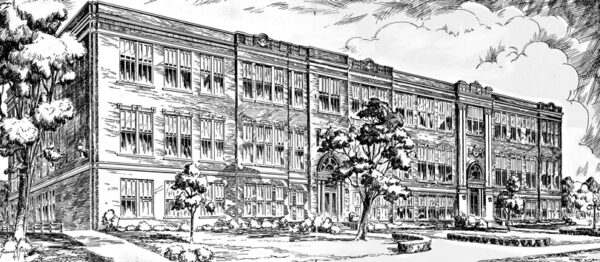
Line art drawing from the Gleam, the yearbook for the 1935 class of William Chrisman High School
A 1935 yearbook title expresses Greatest Generation American Dreams
The ending verses for the Alfred Lord Tennyson poem are listed here in sentence format not in the original one verse per line format: Not of the sunlight, Not of the moonlight, Not of the starlight!, O young Mariner, Down to the haven, Call your companions, Launch your vessel, And crowd your canvas, And ere it vanishes, Over the margin, After it, follow it, Follow The Gleam. The person or team that selected this theme chose a most powerful metaphor for connecting the past and present to the future of the class of 1935. I often think of this profound expression of optimism from this High School class in 1935, the depths of the depression.
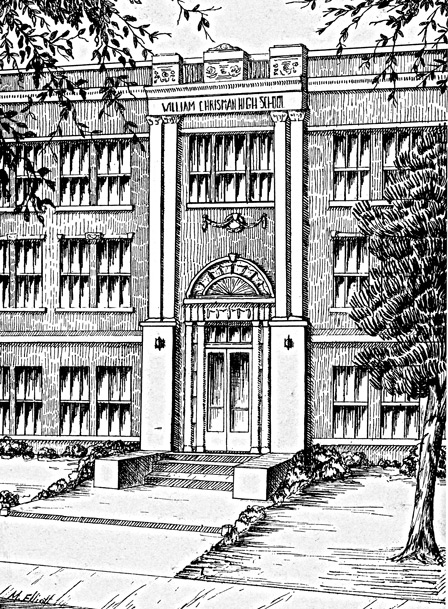
North Door Line art drawing from the Gleam, the yearbook for the 1935 class of William Chrisman High School Greatest Generation graduates
Whaling voyages in the 19th century were lengthy, often more than one year, and perilous with fatalities for crew members or the loss of the whole ship. The ship captain’s house sometimes had a view of the harbor where the ship would return. The Widows Walk, a porch on the roof, was where the captain’s wife would look for the return of the ship. The Whaling Vessel metaphor expresses the reality of whaling voyage dangers. The William Chrisman 1935 graduation class had survived troubled times. They had faced starvation during the dust bowl, war was brewing in Europe, and Japan had invaded and enslaved Korea in 1910 and was invading China as the graduation ceremonies commenced.
No form of expression except poetry could communicate this confluence of culture and history on the cusp of 1935 America. The absence of poetry in education and communication in contemporary American culture is a great loss. Poetry defines an emotional and existential glue that defines a state of mind and a path from somewhere to somewhere else. For this generation reading books was a primary source of information and education for the events in the culture. TV and mass media did not yet exist. In this context poetry and novels had great influence. Radio news was not yet the popular medium that it became decades later.
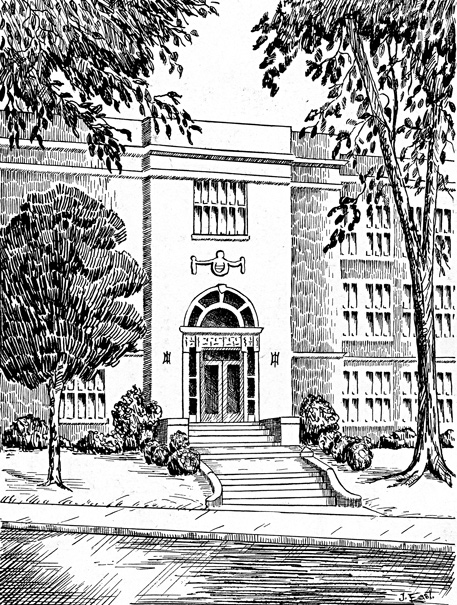
West Door Line art drawing from the Gleam, the yearbook for the 1935 class of William Chrisman High School Greatest Generation graduates
The Tennyson poem and its use as a graduating class theme in 1935 creates a multilayered American culture theme. The whaling era that the poem draws from peaked in the 1840s and whaling was being replaced by the oil industry when the poem was written. The Tennyson poem view is retrospective by about 2 generations. The 1935 Independence High School theme contemplates a poem that is 2 generations old. The Follow the Gleam theme encompasses more than 100 years of American History. Sensing your place in history requires knowing the events, in this case a theme based on several generations of American history. I wonder how many High School students graduating in the 21st century have a keen sense of 100 years of American History.
The mother of all trails high school Greatest Generation alumni notes
The mother of all trails, Independence Missouri, also known as the Queen City of the Trails, founded in 1827, fosters an adventurous spirit. It was the starting point for the Oregon, California, and Santa Fe trails. In 1935 the city was no longer the transportation hub for the westward expansion. The adventure spirit of the city was evident in the Yearbook. Alumni notes, excerpts from the yearbook, portray the impact of this small Midwest town on the world. William Chrisman Alumni were working in Walt Disney Studios, and Sigmund Freud’s clinic in Austria, Harry Truman was a US Senator, and alumni were teaching in the Panama Canal zone, and several states and foreign countries. This small Midwest town, population 15,000, had an international impact. William Chrisman high school graduates followed the gleam across the continent and around the world
That optimism, character, dedication, and attitude of service provided the foundation for the next generation. The children of the 50s and many generations beyond were imbedded with this character. The class motto was the gleaners, a term used since biblical times for poor people who scavenged the leftovers from harvests. The theme of the graduation class exhibits a timeless character. They had experienced the greatest challenges in the Nation’s history. They celebrated the present and were optimistic about the future.
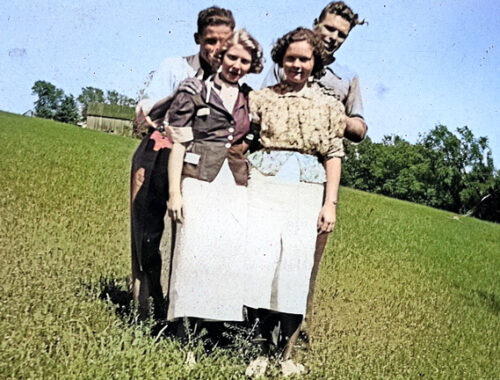
Clifford Immer and friends at Buckner Missouri farm in 1934 his move to Independence took the first step to Follow the Gleam
The coming-of-age story is both iconic and timeless. The story of the next generation, graduating from High School in the 1960s, is represented by a film directed by George Lucas, American Graffiti. The George Lucas biography is set in an agricultural California town, Modesto, in 1962. The America in 1962 was in many ways different from America in 1935. Many elements of the quest for adulthood were the same. The questions about what I going to be, am I going to leave home and find a life somewhere else, and what happens to my relationships with friends, are the same. The soul of the Greatest Generation exhibits a timeless character. The exploration of this character leaves me with a profound thirst to understand its depth.
The character of this class, expressed by sayings like, “an honest day’s pay for an honest day’s work “, underlines their status as the Greatest Generation of parents. There was no love greater than family and no sacrifice they would not make for the welfare of their family. It has been my pleasure and privilege to be a child of the Greatest Generation.
A 1935 senior trip embodies Greatest Generation American Dreams
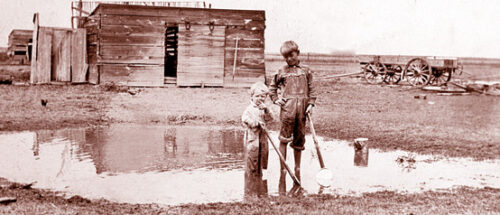
Greatest Generation children play after Colorado plains rainstorm 1925
Clifford Monroe Immer was a graduate of the class of 1935. His family had moved from the plains of Eastern Colorado to Independence. The family was struggling but surviving. High School graduation was a cause for celebration. Clifford and a few friends planned a senior trip. They would borrow a car and pool their resources for a few gallons of gas to drive about 100 miles to the newly formed Lake of the Ozarks for a weekend camping trip. 1935 Willian Chrisman graduates envisioned a celebration of the yearbook theme to follow the gleam. The 18-year-old graduating senior’s vision of paradise is realized by a senior trip to the newly created Lake. A creative and inexpensive senior trip symbolizes hope.
The summary and some details of the senior trip were told to me by my father, Clifford Monroe Immer. I would like to know more about their conversations that weekend. Was it a joyful time swimming and exploring the lake? Did they talk about the war in Europe that some of them would fight and die in? Did they talk about the job that they hoped to find? What I do know is that their character, dedication, and attitude of service was passed on to the nation and their children.
1935 graduate’s hope and optimism Follow the Gleam to Lake of the Ozarks
When completed in 1931, it was the largest manmade lake in the US. The primary purpose was hydroelectric. The lake is located in the Missouri Ozark mountains. Recreational use developed very slowly in the rural area around the lake until a decade or more after the end of the depression. The only roads into the lake from surrounding small towns were unpaved roads to access farms. There were no facilities or services on the 1150 miles of waterfront in 1935 when the senior trip was planned.
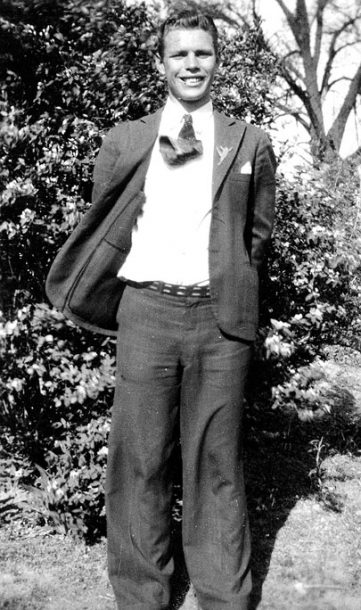
Clifford Immer Best Generation high school graduate 1935 Follows the Gleam for a senior trip
Route 66, the first interstate HWY, was not completed until 3 years later in 1938. Before Route 66 there were no services, no gas stations, and the unmaintained roads could destroy your tires. The best roads commonly used for travel between cities were gravel or graded dirt. The roads to the shore of Lake of the Ozarks were ungraded rocky roads that had once led to villages that had become underwater ghost towns. The unpopulated hardwood forested shoreline did not have any services or accommodations. The exploration of the lake was not constrained by any rules. The boys could camp wherever they wanted and swim wherever they wanted. The lake with more than one thousand miles of shoreline was their private domain until they ran out of food and decided to go home.
Automobile travel over long distances involved unsigned, unmaintained and unpredictably impassable roads. The senior trip group was aware of road hazards and were prepared. The sharp rocks from the geology of the Ozarks were piercing the tires and innertubes so that they could only drive a mile or two before they got another flat tire. They had brought a repair kit so that they could patch the tire and reinflate it with a hand pump.
A 1935 Greatest Generation graduate and brother-in-law Follow the Gleam
Across the state, on the other side of the Mississippi River in Illinois, Mary Helen Smith was contemplating her 1935 high school graduation. She had been orphaned by her coal miner father’s death 10 years earlier. Her brother-in-law, Louis Warford, had taken in two orphans, her and her cousin Tyke Kelso. Louis fished locally in the Illinois River.
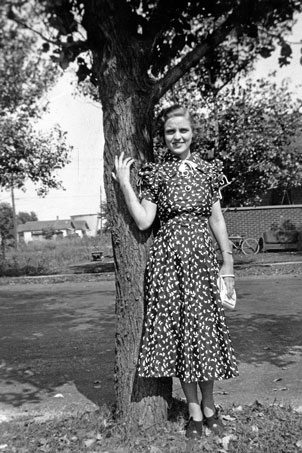
Mary Helen Smith 1935 High School graduate new dress celebrates Greatest Generation graduation
He occasionally travelled to Lake of the Ozarks for fishing and took Mary Helen with him. The weekend fishing trips during the depression were an expression of a working-class vision of Greatest Generation American Dreams. The brother-in-law fishing trips reveal the working-class family’s vision of American Dreams and the economics for weekend trips during the depression. The accommodations were likely an unheated shack with one bed and no running water. Several family members or my uncles fishing buddies could sleep on the floor for one dollar per night.
A family retreat realizes Greatest Generation American Dreams

Greatest Generation graduates wedding photo 1940
In 1937 the Immer family moved from Independence Missouri to their ancestral home, a farm settled in 1885 by his grandfather Fred Immer, near Highland Illinois. Clifford Monroe Immer met Mary Helen Smith at a church in Alton Illinois. They were married In December 1940. Clifford Monroe Immer was working as a refinery maintenance supervisor for Shell Oil Co in 1951 when he decided to buy property on Lake of the Ozarks.
The lake was 180 miles south of their residence. The property would serve the family interest in swimming and fishing on weekends and vacations. He bought 7 acres with 800 feet of waterfront for $1000 on Duckhead point. The area was undeveloped. The undeveloped status of the lake created a working-class paradise. The area around the property was essentially a private lake surrounded by hundreds of acres of forest. There was no housing, electricity, or running water at the property.