Henry David Thoreau experienced his model of simple living in natural surroundings living in a small shack at Walden Pond. The location is about 2 miles from the town of Concord. Because of isolation from community activities, he was able to devote this time, 2 years 2 months and 2 days, to meditation. His conclusion was, ” the beauty within us makes it possible for us to recognize the beauty around us”. Steven Hawking’s personal world view, that “genius is the process of being humbled by reality”, motivated his discoveries in physics. Thoreau and Hawking’s themes provide examples for the humble childhood experience creating memories of forests, creeks, and ponds to reveal the beauty in them.
Generations of forest creeks and ponds childhood memories
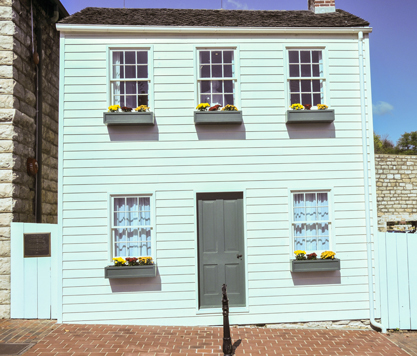
Mark Twain’s house Hanibal Missouri photo 2011 by rodger
Mark Twain wrote about his childhood memories of forests creeks and ponds at Hanibal Missouri. The adventures of Tom Sawyer, written in 1876, immortalized his experience. As a result, his childhood view of life on the Mississippi River at Hanibal foreshadowed the lucrative and adventurous profession of a river boat captain. Subsequently he had signed on as a pilot’s apprentice in 1857 while on his way to Mississippi. Accordingly, on April 9, 1859, a 23-year-old Samuel Langhorne Clemens, also known as Mark Twain, received his steamboat pilot’s license. Subsequently on trips to New Orleans and other ports on the Mississippi River he passed within one half mile of my view of forests creeks and ponds at Alton, Illinois. He saw the same fall colors and bayous that I saw as an 8-year-old in 1951. Consequently, this shared experience expands my childhood memories.
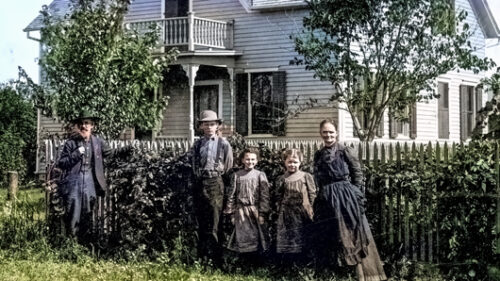
Oswald Kile, my great, great grandfather and daughters’ family Deck’s Prairie house 1903
photo edited and colorized by rodger
Four generations of my family experienced the Silver Creek Census Area defined in 1820 for Madison County Illinois. As a result, the effects of the multigenerational experience expand my personal dimensions of this sense of place. After Illinois became a US territory in 1809, the county was defined in 1813. My great-great grandfather Oswald Kile was born in what had become the township of Marine in 1827. This town is about 2 miles from the forested Silver creek. My great grandfather Fred Immer was born in 1862 in the Marine township. He bought 270 acres on Silver Creek in 1885.
Fred Immer operated a dairy farm and fished in Silver Creek until his death in 1935. His son, my grandfather Fred Immer was born in 1890 at the farm on Silver Creek. After living in Colorado and Missouri, he came back to the farm on Silver Creek in 1937. He operated the farm until 1956. I lived on the farm on Silver Creek during WWII and occasionally spent weekends there during my childhood from 1945 until 1955.
More generations of forest creeks and ponds childhood memories

Woods Canyon Lake Arizona campsite 1993 photo by rodger
My wife’s profession as a park ranger and college teacher of education methodologies for docents in the 1990s revived and intensified my childhood memories of forests creeks and ponds. Consequently, our family tent camping trips to more than 100 national and state parks included careful planning to find the most secluded and picturesque campsites in redwood forests, rivers, lakes and coasts. As a result, our children and grandchildren extend the tradition to 2 more generations.
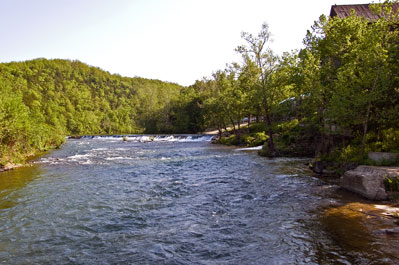
White River in Missouri Ozarks photo by rodger 2007
My earliest childhood memories of forests and creeks began on the White River in the Missouri Ozarks in 1947. Several decades later the montage of memories has evolved from the experience shared with my wife, children and grandchildren. The White River memories of sleeping on the beach, crayfish in the pools at the edge of the river, and the traffic of river rafting on air mattresses, are still vivid. As a result, the 1947 memories frame and enhance the lifelong experience of humility, natural beauty and the beauty in people.
Deer Park Cabin lodge, built by Ben Overturff in 1907 in the San Gabriel mountains near Pasadena, California, accommodated interest in this wilderness area. The location at approximately 3000 feet elevation in the forest also provided relief from the summer heat. Because there were no roads, access was by a difficult trail with a 1600-foot elevation gain. My wife managed the wilderness park where the trailhead to Deer Park is located. Because of her interest in history, her master’s thesis was a biography, she documented the area history with trail signs including photographs and newspaper clippings.
Although the lodge ceased operating in the 1930s, the trails continue to be heavily used. They originated in Monrovia Canyon and are referred to as the Ben Overturff trail. Hikers, mountain bikers, and joggers use Sawpit Canyon Road, which provides lots of views of the Los Angeles basin, several creek crossings, and leads to remnants of the original stone lodge. Several hundred people use Sawpit Canyon Road on summer weekends.
History and landmarks underline childhood memories

Chain of Rocks Bridge Route 66 Mississippi River crossing photo 2007 by rodger
The Chain of Rocks bridge on the Mississippi River was my earliest sensation of a crossroads. It was the way from my house to Saint Louis, Missouri on Route 66. The zoo, baseball games at Sportsmans Park, and the circus at the Kiel Auditorium were destinations for childhood memories. As a result, the ebb and flow of childhood life was on Route 66 crossing the Chain of Rocks bridge. Because of my childhood emotional connections, I revisited the bridge, in 2007, on a trip from California to Midwest destinations. Because of improvements in the highway system, the bridge had closed in 1967. Subsequently the conversion to a state historic park provided foot traffic across the river from Illinois to Missouri with views of the Saint Louis skyline to the south.
Waldon Pond, near Boston Massachusetts, served Henry David Thoreau’s quest for meditation in a setting of natural beauty. To clarify Thoreau’s experience, I travelled to this location on a summer weekend in 2009 to revisit his childhood memories of forests creeks and ponds. The sensation I experienced was a crush of people and cars. Parking lots overflowing with cars sandwiched the reconstruction of his cabin. Layers of people covered the beach from the road up to the edge of the pond. Because this location was no longer an island of solitude, meditation on the natural beauty required tuning out the screaming children and chatty adults. Consequently, I was not able to experience this location the way Thoreau did.
Forests creeks and ponds provided perfect children’s habitats
The topography of my grandfather’s farm, 20 miles from my house in Roxana, Illinois, was not ideally suited for agriculture. Only about half of the land he purchased in 1885, 270 acres, could be planted in crops. However, due to the forest, creek, and ponds the topography of the farm was ideally suited for the exploration 8-year-old style perfect childhood habitats. The property was located about 2 miles from the small town of Highland, Illinois on a section of land called Deck’s Prairie. Because of my frequent visits, the farm rapidly became imbedded in my childhood memories of forests creeks and ponds.
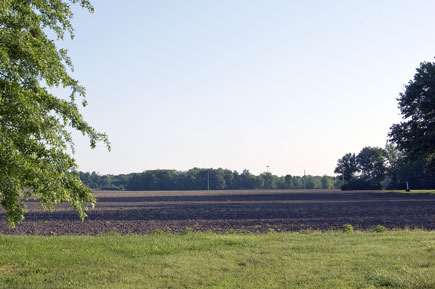
Deck’s Prairie Illinois farm view from South end in 2007.
My solo baseball practice was one half mile North West.
Photo by Rodger.
A forest of Oak and other hardwood trees covered several sections of the 270 acres of the farm. Silver creek ran through a hardwood forest the length of the farm on the east side. My great grandfather cleared some of the hardwood forest during the 1880s to create more land for cultivation. Patches of hardwood forest, a few acres in size, on the creek and north and south border remained when I first began to explore the farm as a 6-year-old child in 1949. Some areas of the farm, that were not level, were eroded from seasonal creeks and the water runoff from slopes. The mini hills and valleys from the erosion, my cousin and I called them piggybacks, were the right size for childhood adventures and scrambling.
The western section of the northern border, about 30 acres, was level and had been used for an orchard in the 19th century. Since this space was unused for crops it briefly served as an archery range. My father decided to show me how to string and shoot his father’s double recurve bow. The bow was 54 pound’s strength and very difficult for a 10-year-old to string. My father could pull the full strength of the bow. We tested the range and measured the distance. The arrows travelled more than 300 yards.
A blend of urban and wilderness locations created children’s habitats
In 1955, just before my 12th birthday, my family moved from Roxana, Illinois to Anacortes, Washington. We left behind extended family, friends, and the ancestral farm that had been my private playground from my earliest childhood memories. As a result of the move my father was getting a better job by accepting an assignment at a new Shell Oil Co refinery in Washington State. Since his supervisory position was on the day shift, he no longer had to work night shifts.
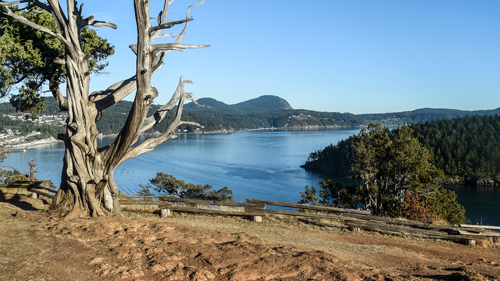
Fidalgo Island view from Washington Park photo by rodger 2011
Our house was in a new subdivision developed for the demand created by the construction and operation of the new refinery. Consequently, location on the northern edge of the town of Anacortes, on Fidalgo Island, provided easy access to urban and wilderness playgrounds. There are 9 lakes on the island. All of the lakes were within a 3 mile walk of my house. During my stay at the motel, while waiting for the completion of our house, I dabbled in a creek that came from Heart Lake. My love of baseball, I started playing little league at age 8, quickly adjusted to the local organization and venues. The lighted field on main street about 1 mile from my house hosted the little league games and accommodated ad hoc games at all hours of the day.
Heart Lake, one half mile south, was the most frequent destination for my childhood hangouts. The 64-acre lake was multipurpose. Part of the lake was silted but some areas had sandy beaches perfect for swimming. The fishing was excellent and opening day attracted hundreds of fishermen who set up camp the night before. There were no designated camp sites. The evening before opening day included campfires, lots of comradery among fishermen and newfound friends, and lots of beer. Mt Erie and Erie Lake were another half mile south. The one-thousand-foot climb, and trails on Mt Erie provided a perfect domain for a child to explore. Heart Lake added dimensions to my childhood memories of forests creeks and ponds.
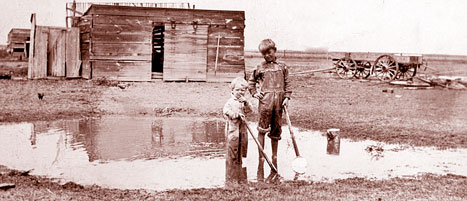
Father and uncle Eastern Colorado plains 1925
photo edit by rodger
Any body of water will capture the interest of a child, including a puddle on the prairie after a rain. My next-door neighbor and other close friends accompanied me to Heart Hake. Since there were no trails there in 1955, exploring the lake meant bushwacking your way around the lake. Some of the friendships that developed at Heart Lake were lost when I moved to Arizona several years later. The friendship with my neighbor revived, because he had moved back to his Long Beach, California hometown in 1964, when I moved to Long Beach California in 1966. Many vivid childhood memories of my Heart Lake habitat have persisted and define an emotional anchor to a very special sense of this place in my life.
Childhood Memories finding solitude at forests creeks
Forty years after leaving Illinois in 1955 I was still having dreams about a location on my grandparents’ farm. Most of my visits to the farm in the spring and summer months included a one-half mile walk to Silver Creek on the Western boundary of the property. A field road of unknown origin and not in current use was the most direct path. The road was sunken several feet below fields on both sides and canopied by the varieties of hardwood trees. Since it was shaded the walk was cool on warm days.
The location called the ford, where the field road crossed Silver Creek, was my personal sense of place and a favorite hangout. Since neither air travel nor automobile traffic was audible, the ford was quiet. The only sounds were leaves in the wind and the murmur of the shallow creek. The creek was heavily shaded by trees 15 feet above on the banks. The water table in that area was 60 degrees so the creek was always cool. Consequently, the air in the creek bottoms was cool even on hot summer days. The ford created an emotional massage that soothed the senses of an eight-year-old life that was not without stress.
Generations of solitude discovered and lost to history

Great grandfather Fred Immer and daughters at Deck’s Prairie farm about 1920 photo edit by rodger
Silver Creek served a similar purpose for my great-grandfather. He fished at the creek most Sunday afternoons from the 1880s until he died in 1935. The advances of national transportation and Highland, Illinois development had radically transformed Silver Creek by 1967. Interstate 70 Hwy replaced the farmhouse and field road with concrete roadways and off ramps. Silver Lake was created for a city water supply and covered 550 acres of the creek and surrounding forest. As a result of the interstate highway development, the location no longer exists. However, the childhood memories of forests creeks and ponds for 4 generations of solitude remain.
My treks to solitude personal theme reemerged in 1987 when my wife decided to embark on a profession as a park ranger and geology and biology teacher. During the next two decades we travelled to more than 100 national and state parks as part of my wife’s employment and our personal interests. From my location in Southern California, I explored many trails in the San Gabriel, San Jacinto, Santa Rosa, and San Bernadino mountains.
The experience during my wife’s 1987 geology class field trip resulted in my wife cooking Chateau Briand in a light snow fall on the slopes of Crater Lake National Park. Unplanned events such as a super bloom in Glacier National Park, and a landslide on Sawpit Canyon Road near Pasadena, California added dimensions of solitude. My personal treks to solitude and casual observations of the Mississippi River, about 1 mile from my house in Roxana, Illinois, are from a very different perspective compared to exploration of the Mississippi River by Jacques Marquette in the 17th century.
Tabula rasa childhood memories forest creeks and ponds solitude
If you are not familiar with this phrase you may wonder what exactly tabula rasa means. The dictionary definition reads something like: “absence of preconceived ideas or predetermined goals, a clean slate”. My treks to Silver Creek on my grandparent’s farm or other locations were for the most part ad hoc. The specific route or expectations for what I would see or do was not predetermined. The season and the route, e.g. through the south 40 which was an indirect path to the creek, would take me through a corn field that was tasseling at 10 feet in height and felt like a tropical forest. The east side of the creek, should I decide to cross it from the west where the farmhouse was, contained a hardwood forest instead of the plowed fields on the west side.
A walnut tree on the edge of a pond about 200 yards west of the barn and farmhouse was a frequent destination. The small pond, dug by my grandfather and father when they moved from Independence, Missouri back to the ancestral home in 1937, provided a source of water for the cows. The source of water for the pond was rain from the natural slope on the area around the pond. It was large enough, about 50 yards in length, to support a variety of life for the curiosity of an 8-year-old child. Small fish, frogs, and a variety of insect life including dragon fly nymphs inhabited the pond. I was fascinated by the dragon fly nymph’s ability to attack and eat minnows.
From age 6, when I first ventured out on my own, until I moved out of the state in 1955, I spent many hours at that walnut tree just enjoying the shade and listening to the frogs. I have often contemplated the solitude and missed being able to just sit in the shade of that walnut tree and listen to the frogs for a few minutes. Because that walnut tree was a long-term routine the image connects my most vivid childhood memories of forests creeks and ponds.
Childhood memories of forest creeks defined a personal sense of place
It was my personal sense of place that no one else could experience because there were not there at that time in those circumstances. The location at a pond, that was behind a barn, near a creek, on the edge of an oak forest, on a warm fall day, surrounded by orange and red colors created a unique scene. The emotional dimensions of a sense of place, how it was perceived and felt, are defined by the configuration of physical, biological, and psychological context with a meaning beyond the parts. The sensual and emotional bond defines a gestalt montage, a technique used by filmmakers to compress all of the elements of a scene.
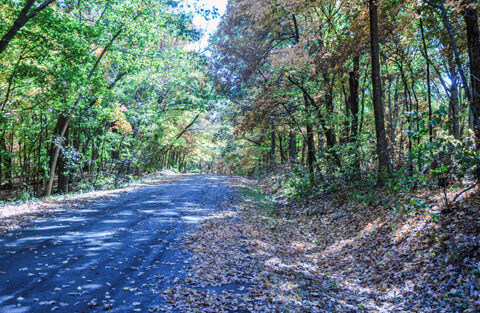
Great River Road at Hanibal Missouri photo by rodger 2011
The 7 miles of the Illinois Great River Road, designated State Highway 96, from my house in Roxana to Alton, Illinois defined a sense of place for historic locations. The Lewis and Clark 1804 base camp, the exploration of the Mississippi River by Marquette and Jolliet in the 17 the century, the River Boat captain Mark Twain trips down the Mississippi River in the 1850s, and the 1100 AD Mississippian Indian Culture city Cahokia were all located on this route. The confluence of the Mississippi River with 1000 years of culture defines a universe of childhood memories of forests creeks and ponds.
Many scenes in my personal history occurred on the Great River Road in Alton. I was born at Alton Memorial Hospital on the bluff overlooking the river. I learned to ride a bicycle at Lincoln Douglas Park in downtown Alton. My first stereo sound wide screen movie was at the downtown theater. My mother attended the Cosmetology School downtown, and I noticed the Piasa Bird Indian painting on the cliff during my frequent trips. The Great River Road and Alton montage of scenes and activities is connected to so much of my life that I can’t imagine being the same person without them.
Biology and locations define and enhance childhood memories
The biology and weather at my grandparent’s farm, near Highland Illinois, created a unique matrix of auditory and visual sensations. The hardwood forest on the northern and western edge of the farm contained a mixture of Black Walnut, Red Maple, Cherry, Box Elder, Elm. and Oak trees that canopied the field road. The combination produced a kaleidoscope of colors during the fall. I frequently walked the field road on the northern edge of the farm to get to Silver Creek. I thought this was my private road since it had not been used for decades. The unusual and unexpected fall weather pattern and the unique biology of the forest defined a once in a lifetime sense of place.
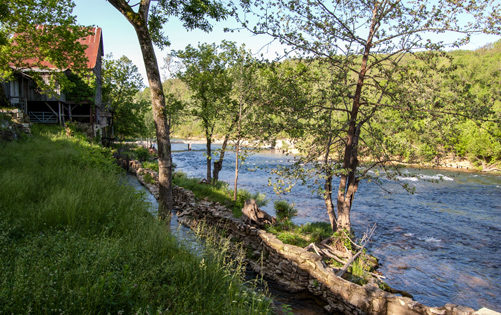
White River site of my first campsite in 1947 photo by rodger 2007
My first awareness of a very special place that would never disappear from memory was at the White River in the Missouri Ozarks at age 4. It was my first camping trip and a family reunion of sorts. My father and younger brother had been discharged from WWII less than 2 years earlier in late 1945. State parks and formal camp sites did not yet exist, the Ozark National Scenic Riverways national park was not created until 1964. The roads were unpaved and traversing between rivers required driving across creeks. My father had just purchased a 4-wheel drive jeep, so he took great satisfaction in exploring the country roads and finding the perfect sandy beach to put down our sleeping bags.
The Ozark Rivers have always felt like home even though I have lived near Huntington Beach California for 50 years. My grandmother and great grandmother lived in Hartville, Missouri until 1914 when they moved to Colorado. Hartville is a few miles from Mansfield, Missouri, Laura Ingalls Wilder’s, the Little House on the Prairie author, home. Because my childhood view of the world was shaped by experience in the Missouri Ozarks, it was always my dream to own property on a spring fed lake. Work and family have taken me to other locations that I call home. However, I have never forgotten that dream.
Forest creeks geology and biology vitalized childhood memories
At age 6 I visited my great uncle’s farm near Bryant Creek in the Missouri Ozarks. The occasion was an unofficial but important family reunion. Three years earlier my father and his younger brother had returned from service in WWII. My great uncle had served in WWI. Ten people from 3 generations of the family were there. After a dinner including gooseberry pie, which I thought were peas and asked that they be removed from my pie, I watched the fireflies come up over the fields next to the house. There are a large number of caves in Missouri. As a result, there was a cave on my great uncle’s farm. The group, including myself and my 3-year-old cousin, explored the cave. My memories of what I saw in the light from flashlights was undiscernible shapes, and a lot of mud and water.
A family trip in 1993 was multipurpose. My daughter graduated from High School that year. She had enjoyed a decade of family tent camping trips to National Parks and was looking forward to the trip. We planned to travel across the Southwest from Albuquerque, New Mexico, to visit National Parks we had not yet seen and then north to Illinois to meet with extended family. We flew to Alburquerque, to reduce the travel time, and rented a car for the rest of the trip. Airport security did not like my tent stakes in the carryon baggage, so I checked them with other baggage.
At Bandelier National Park we arrived after the nature center had closed but still had time before sundown to climb the cliff face on ladders and do a walking tour of the site. My time at the planned destination in the Ozark rivers was shortened by a side trip to visit one of my daughters’ friends in Arkansas. Although we did not reserve campsites in advance, we found a space at Round Springs on the Current River when we arrived after dark at 9 pm. The next morning, we travelled 9 miles in a canoe on the Current River and toured the cave.
Family travels in the 80s and 90s were coast to coast

Rustic cabin on the Saco River near Conway New Hampshire photo by rodger 2017
Family travels to experience biology and geology spanned decades and coast to coast destinations. After my daughter moved to Massachusetts the focus of family adventures became New Hampshire. A cabin, without water or bathroom, on the Saco River became a traditional fall destination. My daughter managed to reserve the same cabin, #2, my grandson’s favorite location, for more than ten years. The grandchildren came prepared for wading in the shallow areas of the river with boots. The trails on the banks of the river and on the mountain slopes unveiled magnificent vistas of fall colors.
Family camping trips during the summer in the 80s and 90s almost always included gold and silver mines that had been converted to tourist attractions. The best example is the silver mine at Wallace, Idaho. The tours included demonstrations of mining operations. The machines used to drill for the dynamite placement were turned on and the holes for explosives created.
More forest creeks geology and biology childhood memories
I discovered my favorite state park on the homeward leg of a family vacation in 1989. Big Basin Redwoods State Park, near Santa Cruz, California, has a unique combination of geology and biology with camp sites nestled in the trees on the banks of a creek with a view of the ocean. The city of Santa Cruz is a few miles away with a beach, boardwalk, and a roller coaster. Banna Slugs, deer and racoons compliment the scene. The accommodations included individual camp sites and tent cabins with beds and electric lights. Two years earlier I had stayed in a campground outside the redwood grove. We experienced a geologic event up close and personal. A moderate earthquake awakened us. Neither roads nor infrastructure were damaged, so we proceeded north to destinations on our vacation trip.
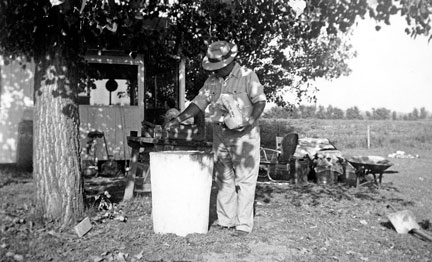
Uncle Louis cleaning fish at Illinois River cabin near Hardin 1949. Substitute father during WWII, best friend, and dedicated fisherman. Photo edit by Rodger 2007.
At age 3 my uncle introduced me to geology and biology that it has taken a lifetime for me to comprehend. My father was in the south Pacific. My mother and I were living with my aunt and uncle in Wood River, Illinois. My uncle Louis was a fisherman. In the 1950s in the midwestern United States this title carried a lot of information about the person it was applied to. A fisherman’s reading list started and ended with Field and Stream magazine. Fisherman preferred fresh fish for dinner and lots of it. They had a personal technique and style for the lures they created, called flies. Fishermen were experts in local biology, geology and weather as it related to the species that they intended to catch. They were patient, kind, and loved to educate children in the knowledge and skill they needed to become fishermen.
Geology and biology down the road childhood memories
My uncle found a location about 20 miles from his home in Wood River, Illinois that provided a diverse habitat for fishing and hunting. Macoupin Creek, after a 100-mile-long course through southwestern Illinois, merged with the Illinois River near Hardin, Illinois. The biology of the creek was different from the Illinois River less than 100 yards downstream. The creek was much shallower and slower moving that the river. The creek was less than 50 feet wide and completely shaded. We caught bluegill in the creek. They were small and you had to catch several to make a meal. The river had blue catfish and carp that were much larger. Bait for fish in the creek was available under foot. Worms were the best bait, and the river bottoms was a perfect place to find them in the mud.
Cave exploring was an infrequent but important family routine. There were several caves operating commercial tours that we could see on a day trip from our house in Roxana, Illinois. Onondaga Cave was our favorite. If relatives from out of state visited, we took them on a tour. When my wife and I travelled from California to Illinois to meet my relatives one year after our marriage, we went to Onondaga Cave. By age 10 I felt confident to wander off from the group and explore the cave on my own. This caused some anxiety for the tour guide. The lights were turned off after a section of the cave had been explored so I was wandering around in the dark part of the time. The small lake outside the cave had a large number or rainbow trout. Feeding them crumbs was not encouraged but fun.

Dawt mill on the White River historic site plus fishing and canoeing photo by rodger 2007
The geography of Ozark rivers and lakes is the context for generations of adult and childhood memories. My grandmother Cuma lived in Hartville Missouri from her birth in 1900 until she moved to Colorado in 1914. I visited father’s niece’s farm on Bryant Creek, near Ava Missouri, in 1951. My great uncle Harry farmed near Ava and retired to live on Lake Taneycomo Lake near Branson Missouri. Dawt mill on the White River defines period history.
Geography expands forest creeks childhood memories
Yosemite Valley was on the agenda for our first family camping trip in 1978. My daughter was 3 and my son was 5. The experience was the inspiration for 2 decades of trips and the formation of a family traditions. A decade later my wife decided to change professions from Information Technology to a park ranger and university teacher. The campsite, geology, and donkey rides were a perfect menu for grandparents, parents, and children’s activities. The lower Yosemite Falls trail and Indian Caves provided an accessible spectacular geology experience and made for children playground.
Sprague Creek campground at West Glacier National Park is a candidate for the best campsite I have experienced. The location has geology, biology, ambience and convenience. A short walk from the camp site to the convenience store provides for food, ice or other camping needs. Lake McDonald and Sprague Creek are nearby. We watched beavers maintain their house and my son and daughter paddled a boat to explore the creek. White water rafting options can be adventurous in the spring when the rivers are high or a gentler scenic tip in the late summer. Horseback rides were available and elicited some horsemanship when my daughter’s horse slipped and fell down in the creek.
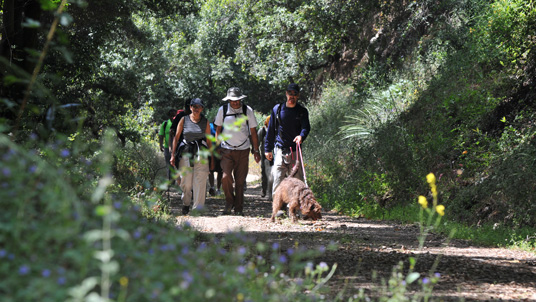
Sawpit Canyon Road in the San Gabriel Mountains near Pasadena California photo by rodger 2013
The Sawpit Canyon Road, in the San Gabriel Mountains near Pasadena, California, has hundreds of thousands of visitors per year. The location is well known by local residents and attracts hikers from across the country. As a result, the forested Creekside Road fulfills a variety of interests for outdoors enthusiasts. For instance, joggers have unlimited miles for their work out with connections to other trails and mountain roads with varying challenges of grades to choose from. Mountain bikers can accept the challenge of elevation gains of 4000 feet and 40 miles or more of round-trip routes. Leisurely walks with dogs can consume the whole day to cover several miles of trail. My park ranger wife and I walked 3 miles of this road 19 times to do habitat studies for butterflies.
Childhood memories of movie sets inspired adult exploration
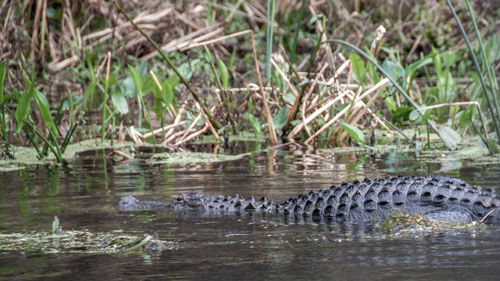
Wakulla Springs Florida location for Tarzan and Creature from the Black Lagoon childhood memories of movie sets photo by rodger 2007
My childhood memories of favorite movies and characters did not include awareness of sets and locations. Four-year-old perceptions of the plots and actions assumed that these stories took place in a country on a continent far away. As I researched destinations for family trips decades later, I discovered that favorite characters, particularly Tarzan, and the Creature from the Black lagoon, swung through the trees and swam at locations that I could book a plane flight to. The resort at Wakulla Springs presents a unique combination of 30s architecture, period style accommodations sans telephones and TVs, and ambience.

Canopied road near Tallassee Florida photo by rodger 2007
In 2007, when my children were not available for a family gathering on Christmas, I travelled to Wakulla Springs near Tallahassee, Florida. The tour for exploration of the motion picture sets provides a close-up view of the geology and biology of the springs. Alligators, manatees, tropical birds, and fossils at the bottom of the springs are a unique experience different from any site I have seen. The Tallahassee subtropical climate supports forests and wildlife that I had never experienced. Huge moss-draped live oaks, sweet gums, hickory trees and pines canopied many miles of roads. The scenes and colors contrasted the hard wood forests of my Midwest childhood.
Parent travel adventures explored forest creeks childhood memories
My parents’ childhood in the 1920s and 1930s did not include travel to far off places. Because of the depression and their working-class circumstances, a nearby lake was the extent of their recreational travel. My father travelled, from his home in Independence Missouri, to the newly created Lake of the Ozarks for his High School senior trip. My mother travelled from her home near Alton Illinois to the Lake of the Ozarks for fishing trips with her uncle.
After their marriage in 1940, their lifestyle changed. I never heard an explanation for their expanded interest in travel. My father’s job at Shell Oil Co, a steady job with good benefits while the country weas still in recession, was likely a factor, During the first few years of their marriage they made cross country trips to: Atlanta Georgia, Minnesota, the Gulf of Mexico, Tennessee, and Colorado. The childhood memories from these trips are vivid and forever. Matagorda Island, Atlanta Beach Georgia, and Iron Mountain Tennessee were major reveals to my 5-year-old senses.
Matagorda Island was in my first view of an ocean in 1948. The beach on the coast of Texas with the island in the background, and the distinctive smell of the ocean are a vision that keeps calling me to come back. Atlanta Beach Georgia was my first experience of a severe sunburn at age 6. The beautiful day meandering the beach and the sound of the ocean waves against the seawall contrast the pain of the sunburn. As a result, the forever childhood memory created a sense that that place was unique. Iron Mountain Tennessee presented a natural climbing adventure. I remember the 5-year-old rush to feel the rocks under my feet and climb to the top of the bolder pile.
Travel adventures favorite camp sites and small town memories
The motivation for exploration, driven by my wife’s interest in geology and my childhood-based search for adventure, resulted in the discovery of more than one favorite camp site. The Smuggler’s campground on highway 89A in Sedona Arizona was discovered partly by accident. Sedona is a very busy place during the summer, even in the 1980s when I started camping there. The campgrounds on the creek filled up regularly.
When we arrived in Sedona in 1988 on a camping trip all of the sites on Oak Creek were taken. We continued on 89A north of Sedona and found a camp site on a smaller branch of the creek. The site did not have water or electricity, no showers, and only portable toilets. It was on the creek, wooded and beautiful. The site was near Slide Rock, a main attraction in Sedona. I returned to this site on subsequent trips to Arizona and camped there the last time in 1995. The site has since been closed.
In our travels before the Interstate Highway System, 40s and 50s, cross country travel was an up close and personal experience. The cafes and cabins were mom and pop enterprises, not chains. We sometimes stayed in a town long enough to go to a local church service before resuming our journey to a destination or toward home. Hitchhiking was common. We never passed a hitchhiker who was in uniform. There was an instant sense of respect between veterans and service men.
Grandchildren traditions favorite creeks and ponds childhood memories
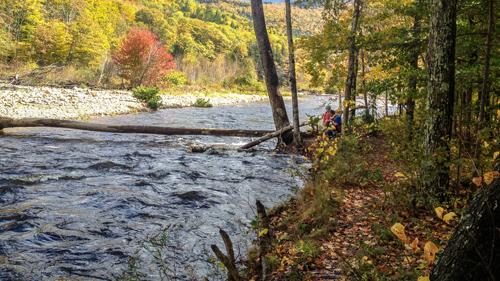
Saco River New Hampshire camp site photo by rodger 2016
The traditions imprinted on my children have been transferred to my grandchildren. The creeks and forests near Conway New Hampshire and Cape Cod Massachusetts became frequent destinations for camping, hiking, and viewing fall colors. Beginning in 2010, after my daughter had moved to Massachusetts in 2008, a camp site on the Saco River in New Hampshire became a standard fall destination. Since I started participating in these trips the site has become one of my favorites. The trip route from Massachusetts provides lakes and geology, Diana’s baths in New Hampshire, in the best fall colors in the country. Forever childhood memories of these locations now reside in my grandchildren.

San Juaquin Marsh Irvine California photo by rodger 2018
There are several forest creeks and ponds a short drive from my Southern California neighborhood. The coy pond at the Long Beach State Japanese gardens became a favorite hangout for my granddaughter. Feeding the fish, watching the bird’s fish, and wandering the trails became a standard Sunday afternoon excursion. Bolsa Chica Wetlands in Huntington Beach, and San Joaquin Marsh in Irvine offer diverse wildlife viewing and education opportunities. The many miles of back roads provide adventure hiking and views of cityscapes surrounded by flowers lakes and trees. A field scope and binoculars are standard equipment for these local excursions.
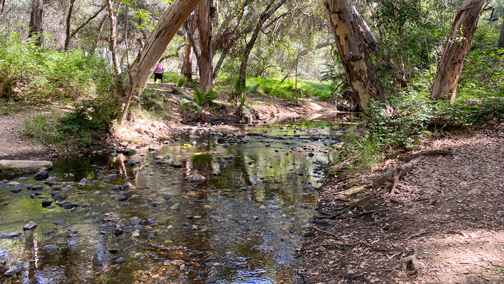
Walnut Creek Diamond Bar California photo by rodger 2022
The nearby San Gabriel Mountains have 970 square miles of forest, lakes, waterfalls, rivers and creeks. Monrovia Canyon, where my wife managed a wilderness park is a 1/2-hour drive from my home in Orange County. In addition to our professional and volunteer activities for habitat studies, trail development, and education programs my grandchildren have enjoyed exploring this wilderness. Walnut Creek near the city of Diamon Bar has been a family favorite. The Monrovia Creek trail has a waterfall and occasional glimpses of a variety of wildlife: black bear, deer, foxes, and bobcat.
Grandfather’s farm forest creeks kindled childhood memories
Roaming creeks and forests near my 50s Illinois home created rich childhood memories. My grandparent’s farm and uncles fishing cabin opened a universe for exploration. Silver Creek on the border of the farm was very slow moving except during spring rains. As a result, it was an ideal natural environment for an 8-year-old to explore. The Illinois River, hardwood forests, creeks, and field roads expanded a child’s senses.
Because my parents played cards or talked sports and politics during visits or weekend stays, I roamed creeks and forests alone. Sometimes I carried a gun for sporadic target shooting or took the dog along to scare up rabbits or groundhogs. Usually, I just walked to various points of interest for my exploration of the farm and surrounding territory. My explorations were usually alone.