Family farms in the 1950s were complex economic entities with many products and sources of revenue generated by small family units. One of the common businesses was production of eggs. The chickens and egg production were usually the responsibility of the wife. I can remember the canning jar on my grandmother’s dresser that filled up with nickels and dimes. Grandmothers egg money was part of the daily routine and supplemented income from other farm operations. When I was 4 or 5 years old, I took my afternoon nap at my grandparent’s farm on my grandmother’s bed. As I walked past her dresser, I often noticed the nickels and dimes in the canning jar. Grandmother’s egg money would fill the jar over a period of a few weeks. The sight of the sheer curtains billowing in the summer breeze and the canning jar on her dresser personalize the scene. The forever childhood memories define the intense sensation of tranquility in that extended family setting.
Dairy farmers came from Switzerland, Kentucky, and Virginia
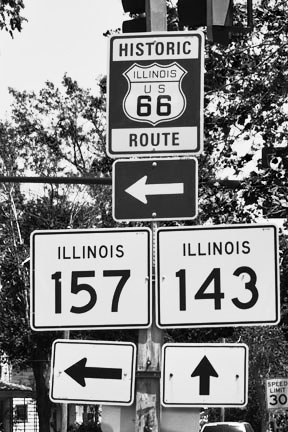
Edwardsville Illinois intersection to grandmother’s house photo by rodger 2007
Illinois Highway 143 travels south through Madison County from Alton, Illinois, where I was born in 1943. At Roxana, Illinois, the highway then turns Northeast through the cities of Edwardsville and Marine to Deck’s Prairie, a location named for a Virginia immigrant in 1828. This highway connected extended family, daily commerce, and recreation in my childhood universe. This was Route 66 through part of the town of Edwardsville. I travelled this highway once or twice per week from 1947 to 1955, approximately 300 times. This route, including all the twists and turns through the fields of corn and wheat and small-town intersections is a forever childhood memory. Route 66 led to baseball games in Saint Louis, Missouri over the Mississippi River on the Chain of Rocks Bridge.
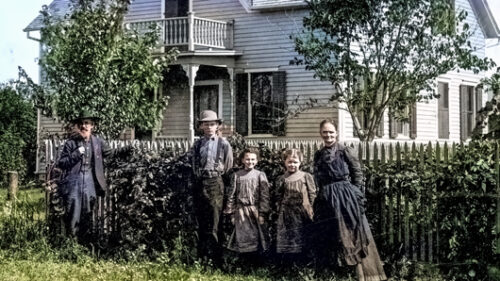
Oswald Kile, my great, great grandfather and daughters’ family at Deck’s Prairie house 1903 photo edited and colorized by rodger
Madison County, Illinois was created in 1812 after the Illinois Territory was created in 1809. The state of Illinois, created in 1818 is a small part of the Territory.
Villages or towns had not yet been defined within the county when it was created. As of 1820 12 locations were defined to aggregate data for the census. The first settler, in a location designated by the name Silver Creek in the 1820 census, is identified by Marine, Illinois historical society documents as 1813. The 1820 United States census identifies 12,000 residents in the county with an area of more than 700 square miles.
The earliest ancestor I have been able to trace is Oswald Kile, born in the Marine Township in 1827. The 1820 census lists only one Kile household in the county. The relationship to Oswald Kile is unknown. The agricultural traditions of these early settlers persisted for many generations. I lived on his daughter’s farm during WWII, 1943. His granddaughter, Ida Immer, lived on her mother’s farm until 1979.
Michael Deck and George Rogers Clark, William Clark’s brother, the leader of the 1804 Louisian Purchase expedition, travelled to the Madison County location in 1778 during the Revolutionary War. Michael Deck returned from Virginia with a wagon train of relatives and friends in 1828. My families’ farm, settled in 1885, is at a location named Deck’s Prairie. My great uncle Ed, the eldest child, was born there in 1887.The Immers family were dairy farmers who had immigrated from Switzerland in 1he 1840s.
Family economics includes grandmothers egg money
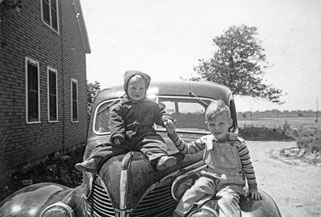
North side of original house in 1950. The log
walls have been covered in siding.
Photo edit by Rodger 2007.
In retrospect, during the following decades, I sometimes wondered how many canning jars there were in Illinois that were filling up with the egg money. How many total in all of the Midwest states? A rough approximation of grandmother’s egg money in 1950 is 3 to 4 dollars per week. This does not seem like much but the average family income in 1950 was only about $3000 per year. The websites that I researched report that there were about 200,000 family farms in Illinois in 1950. So, there were a lot of canning jars filling up with nickels and dimes from grandmother’s egg money.
Many dairy farms grew cash crops such as corn, wheat, or barley. Madison County, where the Immer farm was located, averaged 150 bushels of corn per acre, with the highest recorded yield of 250 bushels per acre. Corn prices in 1950 were about $1.35 per bushel. One hundred acres of corn would produce a significant cash income, several times the average family income in the US at that time. Although many family farms were mechanized, a horse could cultivate 100 acres. A farmer without a tractor could achieve the yields referenced here.
Prosperity in the 19th century included family farm agriculture
The average income for a farm family, in the late 19th and early 20th centuries, was about the same as the income for an urban family working in manufacturing. Some farms did much better than average. The level of success for some family farms is manifested by a phenomenon that was occurring in Long Beach, California beginning in the 1880s.

Great grandfathers farm photo in 1915 my part time home and playground 50s childhood memories
Successful farmers from the Midwest who had been able to afford winter vacations to Long Beach, California were retiring there in significant numbers. A large percentage was from Iowa. The first wave of retiree’s was in the 1880s, the first picknick to celebrate this retirement community was in 1887 with 400 participants. This phenomenon represents a very significant move up the economic ladder for successful farmers. There was no Social Security or retirement plans, which required self-reliance, and there was no Income Tax until 1913 so farmers could save more money. My great grandfather was an investor in the founding of the Helvetia Dairy Co, which became the Pet Milk Co, in 1885.
Farmers and non-farmers understood the linkage between farming and hard work. Some cultures took the dedication to an extreme form. I can remember being in bed ready to go to sleep, in May 1955, and listening to the tractor on a neighboring farm plowing after dark. Tractors did not come with headlights. This farmer had rigged his tractor with lights so that he could plow after dark.
Farm life in the 50s was an extended family affair
Children began helping with farm routines like collecting eggs and milking cows by age 10. Adult children who had jobs and families away from the farm came back at harvest time to bring in crops. My father and his younger brother Fred worked on harvests for their dad long after they were married and had jobs and families of their own to take care of.
When my father worked from midnight until 8 in the morning for Shell Oil Co, he went out to his dad’s farm and worked on a harvest until dark. Uncle Fred had really severe allergies but he worked on the harvests in the dirt and dust just the same. I can remember him wearing a red bandana around his nose and mouth to filter some of the dust out while he was picking up 70lb bales of hay. There weren’t any allergy medications in those days.
My aunt Pearl walked the fields behind a horse drawn plow with her father when she was 8 years old. The daily routines on farms created a family relationship superglue. The absence of the family relationships created in agriculture is a great loss. I don’t think there is anything in 21st century world that can fill that gap.
As a guest and part time resident I was not assigned daily chores
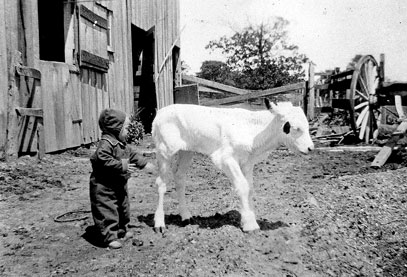
Barn at original Deck’s Prairie house built in 1885. The oak forest and Silver Creek are 200 yards west in background.
1951 photo edit by rodger 2007.
The farm, with hardwood forests, creeks, and ponds was an ideal children’s habitat that involved some risks for an unaccompanied child. Dairy cows are not dangerous, unless you are slow enough and clumsy enough to get stepped on. The chickens, sometimes free roaming, were part of the ambience and grandmothers egg money was part of the financial picture. There are farm animals that are dangerous and there were hazards in the natural environment. My parents declared the pig pen off limits when pigs were being raised. The instructions were that I should not even touch the enclosure for the pigs. Pigs can weigh several hundred pounds and have long tusks. My parents told me that small children who had fallen into pig pens had been eaten alive.
I usually took a short cut across the barnyard to the creek, unless the bull was out. While climbing on an abandoned combine machine I discovered that yellow jackets had nested in one of the grain compartments. Actually, they discovered me before I discovered them. I started running toward the house while 15 to 20 followed me and stung me. Some got inside the shirt I was wearing so it took several minutes to get all of them off. I did not have an allergic reaction, so I just had to endure the pain of several stings. My parents and grandparents decided a doctor visit was not needed. The treatment was some chewing gum to distract me from the pain.
I watched my uncle milk cows and clean the barn, and carried the egg basket sometimes for my aunt but that was as close as I got to any work. The farm was essentially my playground. Even watching farm work has risks. While watching a harvest of hay I fell from the top of a wagon loaded with hay bales onto the wagon tongue and was lucky to survive the incident with no permanent injuries.
Home manufacturing in the 1950s was more common and included a larger percentage of household consumption for farm families than for urban families but there was home manufacturing in urban households as well. My mother occasionally made clothes for herself at our house in Roxana, Illinois. She purchased the clothes for my father and myself at the Sears store in Alton, Illinois. My grandmother made some of the clothes for her and her daughter Barbara. The term “store bought” was a common element of vocabulary in the 40s and 50s. My mother bought clothes and other household items in stores that she could not easily make at home. “Store bought” did not imply lower quality. Some items were higher quality, if bought in a store, so the term “store bought” did not imply lower quality.
Epilogue and perspective 70 years after grandmother’s egg money
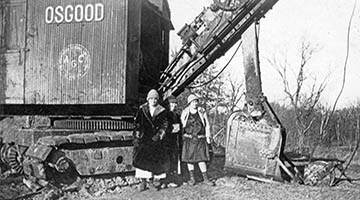
Coal miner wives in Missouri 1925.
I did not continue the legacy of my family’s dairy farming heritage. When I graduated from high school in 1961, I was influenced by the stratus of the US economy, post-World War II, and my relatives to become an engineer. The specific engineering profession was not defined. Their emphasis on the prospective for my wellbeing was to step up from the blue-collar working life to an upper middle-class status. My knowledge of dairy farming ancestors begins in the early 1800s in Illinois and the 1880s in Missouri. I have photographs to trace my coal mining ancestors to Missouri mines in the 1850s. After completing university degrees, I worked as a scientist and engineer for 47 years.
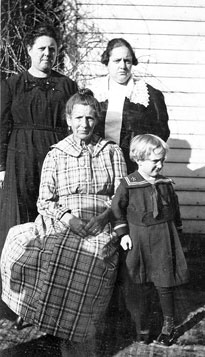
Coal miners’ daughters 1925, Grandmother Eliza back left daughter Elsie, mother, and granddaughter photo edit by rodger
Job satisfaction and financial wellbeing weigh in on the comparison of my lifestyle with my ancestors. My dairy farming ancestors were able to survive hard times during the depression and the dust bowl. There was no government assistance. Hunger and the weather on the Colorado plains were a persistent threat. After moving to Missouri and then to Illinois in 1937 they achieved profitable farming from cash crops and dairy products. Their success was always at risk and dependent on the variables of competent agriculture, the weather, and the economic demand for wheat and corn. They were able to save money and enjoyed a secure retirement when my grandfather was no longer able to work. My coal miner ancestors were paid only for the number of tons of coal that they produced. The work was part time. They did not work and did not receive pay during the summer. The work resulted in a shortened life span. If they survived, they were dependent on their children for support.

4 generations of dairy farmer country school
photo edit by rodger
The opportunity for my dairy farming ancestors to achieve financial independence and security involved risks. Crops failed from the impact of droughts or storms. Harvests and the care of animals were on schedule no matter the weather or how sick family members were with the flu or other medical conditions. An accident disabling a family member affected the welfare of the family. If the right decisions were made for crops and the animals properly cared for, a small family farm could have 5 times the income of a family from a manufacturing job in 1950. Raising chickens provided food for breakfast and dinner as well as a steady income from grandmother’s egg money.
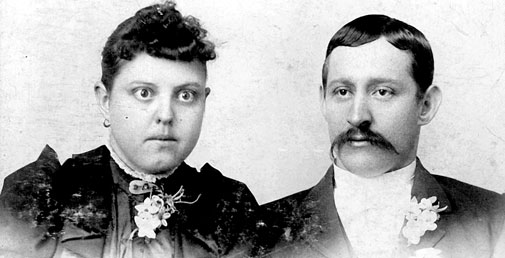
my grandmother was a coal miner’s wife and a coal miner’s daughter, Eliza and Samuel Smith 1890
photo edit by rodger
Federal and state government assistance programs bolster the wellbeing of a family in the third decade of the 21st century. The intrusion into private life by the government agencies results in loss of freedom. No one eavesdropped on the education of my ancestors in the one room country school. The government did not review their bank deposits to investigate how they were spending their money. The newspapers they read were not constrained. Personal identities were not reviewed by bureaucrats. Small town and country life was crime free. Children were free to walk to school without being escorted by their parents. I sometimes imagine having the choice to live free or live with government control of the minutiae of my private life.