Child development psychology emphasizes the importance of routine. 50s childhood neighborhood routines adapted children’s habitats to a specific place and time. The childhood memories are life anchors that point to a sense of well-being and security. The smell of burning leaves and the sight of coal trucks are part of the montage that defines the essential qualities of a forever home. Small town Illinois routines from life in the 40s and early 50s were transported and modified to a new environment in Anacortes, Washington when I moved there at age 12 in 1955. Before television personal interactions on streets and roads defined daily life.
50s childhood neighborhood routines next door
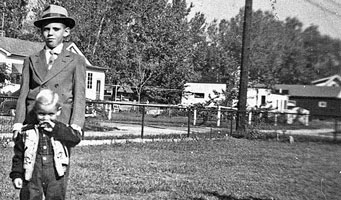
Roxana Illinois 3rd St front yard down the alley to the grocery store
Housing development in Roxana was not organized by tracts. In the 20s and 30s development was one house at a time. When my father built our house on 3rd street in 1947 there were vacant lots on 3rd and 4th streets. There were a variety of fruit trees on both developed and vacant lots. Some of the vacant lots were routinely planted with corn or a garden with a variety of vegetables. The fruit trees on vacant lots were of unknown origin, no one seemed to claim them. Children were aware of the season for the fruit and helped themselves when it was ripe.
The two vacant lots west on Central Ave in Roxana, Illinois was a large enough space for children’s baseball games and community events. I was never aware of ownership for this space. The baseball games were frequent and ad hoc, nobody ever objected. The community annual festival, commonly called the fish fry event, and the travelling carnival that visited once per year, used this space. The space accommodated attendance for city events from the population of the town, about 2000 in 1951. The vacant lots, bordering the yard for my house, provided for the small town character of the neighborhood. The unique availability open space of this children’s habitat fashioned a sense of place where routines became forever childhood memories.
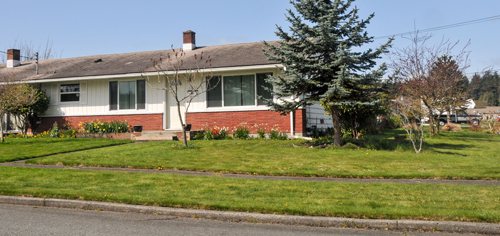
Anacortes Washington house became home in 1955 photo by rodger 2011
In Anacortes, Washington in 1955 the venue for a universal children’s game, Kick the Can, was a street and adjacent hide and seek location. Ideal locations include an adjacent residential area with buildings to hide behind or a wooded area accessible by trails. We played the game on an ad hoc schedule after dinner during the week. Children did not initiate the game on an organized or planned schedule. Two or more neighborhood children being outside at the same time could trigger a request to solicit participants. In my neighborhood in Anacortes, Washington, 4 to 6 children usually participated, although the game can be played with 20. A game started the first year that the neighborhood was created, when the Shell Oil Refinery started operation, initiated friendships among children.
Both children and adults spent leisure time in the 50s playing cards. By age 8 I was playing a variety of rummy and other card games. My favorite for several years was Canasta. I played on my neighbor’s front porch, which was shaded and mitigated the hot summer weather. Pinochle was the most popular card game among my friends and relatives at that time. I played Pinochle later as a young adult.
50s childhood neighborhood hangouts
A nearby pond, creek, trail into a forest, or a favorite recreation site creates a children’s habitat. A hangout location perfectly suits a child’s motivation to temporarily escape the adult world. Creative play at a place across the street or down the road provides a place for adventure to initiate the scene.
Cow Hill, Heart Lake, and Mt Erie, on Fidalgo Island in Washington State, were about one-half mile from my house on 39th Street in Anacortes, Washington. There were small patches of Pine Forest and open fields within 2 blocks. My neighbors were families transferred to Anacortes by Shell Oil Co. in 1955. Some of the families were neighbors in Illinois and some were from other states. There were 12 children within one block with an age range of 11 to 14.
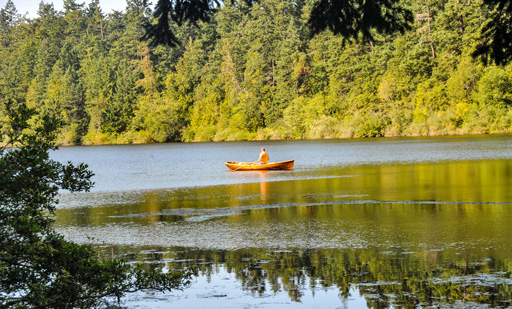
Heart Lake Anacortes Washington childhood hangout in the 50s
photo by rodger 2011
Cow Hill, so named by the neighborhood children, was a real place that is symbolic for locations described by family and friends as their childhood favorite hangout, with the family dog, a sibling, or a friend. Cow Hill was about one-half mile east on 41st street. The summit was about 100-foot elevation scrambling over rocks with no trail. I climbed this hill with my friends many times during the next few years. Heart Lake and Mt Erie were less than one mile from my house. Trails, fishing, and swimming at the small sand beaches define more vivid memories than details of conversations.
The 29th street baseball field in Anacortes provided a linkage and continuity for my years of baseball passion in Illinois. Within a few days of my move from Illinois to Washington in the summer of 1955 I had morphed my life to a new set of baseball friends and new locations. The 29th street baseball field enabled 50s childhood neighborhood routines that included adult and Little League games under the lights at night and continuous impromptu games with children during the day. I felt the sudden detachment from my Illinois life but quickly moved on to the new venue. A teenager named Larry guided me through the youth baseball organizations.
50s childhood neighborhood routines on streets and roads
The Wood River, Illinois pool was swimming Mecca from age 8, when I first started riding my bicycle on the one-mile trip there. The largest swimming pool in the US was built by the Standard Oil Co for their employees in 1929. Standard donated the pool to the city because of low usage by employees. The pool was larger than a football field and had some features of the water parks that became popular in the 1980s.
My family all swam at the pool but after age 8 I went by myself most of the time. The fee to swim for the day was $.25. I never had a season pass, which cost $5, but I don’t remember ever being denied the $.25 to go swimming. I don’t remember the precise schedule but probably swam there 2 or 3 days per week during the summer. The routine for children to walk or ride their bicycles a mile to a recreation site in another city, unattended by adults, does not exist, even in the dim memories of current 21st century culture.
Bus rides to the nearby city of Alton, Illinois for shopping were an essential and memorable family routine. The city of Roxana had only a mom-and-pop grocery store, so clothes and household items required a trip to Alton, population 7000 but it had a Sears, dime store, and other retail. My mother never learned to drive. The bus stop was on our street.
From my earliest memory, age 5 or 6, I was fascinated by the dime store in Alton. It was the only source of toys, which for me was only window shopping since my parents never purchased toys for me. There were many large bins with reading glasses. Most people never saw an optometrist, they tried glasses from the bins until they found a pair that they could read with. A wide variety of merchandise including candy and household items were available. The scale of this retail model was mind boggling for a 6-year-old. It seemed that anything you could imagine was down the aisle somewhere. Dime stores were a large segment of the economy in the 50s, there were thousands of stores nationwide.
Memories of neighborhood sights and sounds define home
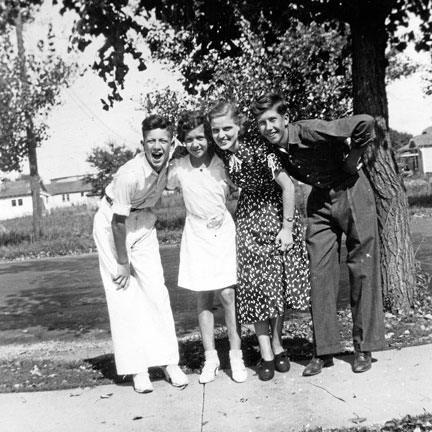
refinery sounds are in the background of this Roxana neighborhood scene photo edit by rodger
The matrix of sounds in my 50s small town neighborhood created many unique patterns. Childhood memories of those sounds trigger intense nostalgia. The absence of automobile traffic is a distinct memory. The small retail district and proximity of the city hall, theater. and high school reduced the need for travel by car. The sight and sound of cars was so infrequent that I don’t have any memories of cars on the streets in my neighborhood.
The airport at Bethalto, Illinois was 3 miles from my house in Roxana. The airport was not commercial at that time. Traffic was light but the drone of small planes was a noticeable feature of the neighborhood. The steam turbines at the Shell Oil Co refinery were less than one block from my house. The sound was similar to a jet engine turbine. The steam turbine sound was low key, not disturbing, but evident 7 by 24 for the 12 years that I lived there.
Sights of people raking leaves, the smoke from burning leaves, and the smell of burning leaves were elements of the phenomenon we called Indian summer. Indian summer days were periods of warm weather, sometimes in the 90-degree range, in late October or early November. The practice of burning piles of leaves in the front yard, the weather, and the smell of burning leaves, are 50s childhood neighborhood routines that define a unique sense of place. This scene from the 50s can no longer be repeated and will never be forgotten.
Childhood memories of places and seasons define a forever home
Children trick or treating in 1950s Roxana did not carry bags to collect the treats. They carried plates. Small town traditions defined a more personal relationship with neighborhood children. Children went to homes within a block or two of their houses. If the homeowner could guess who the child in costume was, they were not obligated, according to tradition, to provide a treat. In practice, the children were always given a treat whether they were successfully identified or not.
The treats were usually homemade popcorn balls, cake, or pie. Since the season was harvest time for fruit trees, fresh apples were a common treat. The tradition for Halloween was for trick or treating to occur on three days, 2 days before and the day of. This element of small town culture nurtured 50s childhood neighborhood routines that are forever memories and an emotional placeholder for the way things were and never will be again.

My mother’s childhood home with her sister and brother in law photo by rodger 1998
A coal truck parked at a neighbor’s house was a sign of the season. People started heating houses by early November. The winter’s supply of coal must be in the basement storage room by then. The price of coal in 1950 was about $15 per ton, which would heat a house for the season. I do not remember the cost for heating a house as being a significant budget item in 1950. The translation for comparison to current dollars, as of 2020, would equal approximately $200 for a year. The Cost for homeowners, in a similar winter climate, to heat houses in 2020 typically costs $1000 per month. The contrast is startling. The good old days were not all good, but some things were much better.
Steam heat was the standard for public and private buildings. Radiators were always nearby. The heat was not evenly distributed to the room, it was too warn near the radiator and too cold several feet away. The heating systems of the 50s, coal furnaces and radiators, are rarely seen except in old buildings where the remnants have been disconnected but not removed.

A short walk to Groceries and news
photo by rodger 1998
My 50s hometown was a place where people walked: to work. to shop, to get a haircut, to pick up the mail, to pay bills, and to go to the theater. City offices were across the street and schools were on the next block. My neighborhood memories are framed by daily routines intertwined with familiar names and faces. The personality of the town and the sense of place were shaped by the small-town logistics and the longevity of the social networks created by an industry that had been stable for decades.
Favorite location childhood routines define habitats and memories
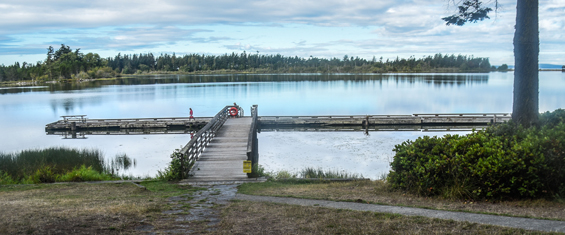
Cranberry Lake Whidbey Island Washington State
photo by rodger 2016
Cranberry lake on the north end of Whidbey Island in Washington State, about 9 miles from my house, was my favorite location to hangout when I moved to Anacortes, Washington in 1955. The 134-acre lake had two beaches for swimming. One beach included a building to shower, change clothes, and buy snacks. The other beach provided access to the lake and the adjacent ocean. The mothers in the neighborhood cooperated with the carpooling to take groups of children to the lake. The routine for Cranberry Lake was at least once a week during the summer. The lake functioned as a children’s habitat for Skagit County, with a population of about 40,000, and other adjacent counties. There were always neighborhood and school friends there.
Greenville Lake was a favorite family hangout from the time that I was old enough to swim, 1950, until we moved to Washington State in 1955. A hardwood forest bordered the 40-acre lake on 3 sides. A sand beach, two diving platforms, and a slide provided varieties of swimming experiences. The routine was ad hoc trips for swimming, sometimes including a picnic lunch or dinner, on days that my father was not working or in the evening after work. The ambience was much different, fewer people and a natural setting, from the swimming pool near home. My childhood memories of these outings are a family mood that was lower key and focused on enjoyment of the recreation experience.
Family routines included a logbook for Sunday afternoon flights
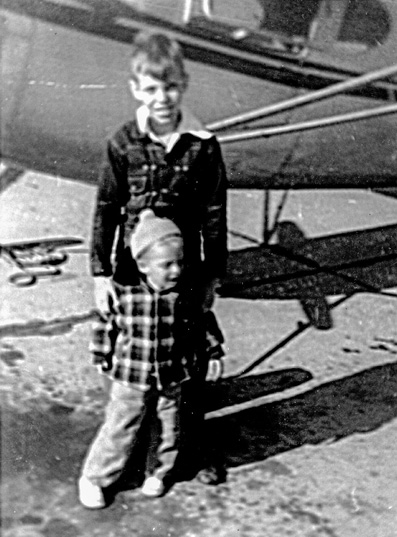
Sunday afternoon plane rides were a frequent family routine
photo edit by rodger
My father’s use of his GI bill money to get flight training created a unique family routine. He completed a commercial pilot certification. He never mentioned a goal of becoming a commercial pilot, he just liked to fly. The school duration was 132 weeks of training, including recertification in 1949. The cost was $2,500, approximately $35,000 in 2023 inflation adjusted dollars. I sometimes went to the airport where the training was given during his school and of course flew with him after he got his license.
An airport had been built by a local entrepreneur at Bethalto, only a few miles from Roxana. The airport was quite small but the interest in private aviation was growing after the war. The planes that we flew in were Pipers and Cessnas. The model information is in my dad’s flight logbooks.
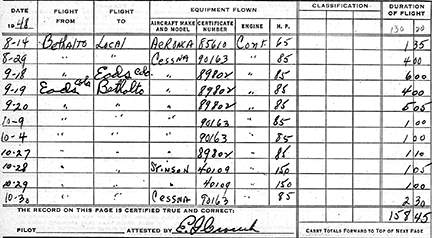
1948 flight logs cross country and Sunday afternoons
photo by rodger
Flight logbooks are the official information for a pilot’s certification and document flying skill and experience. They are maintained in meticulous detail. The flight logs are among the family memorabilia that was passed to me by my parents. They will be kept by my children for future generations of Immers. The planes were 3 or 4 passenger. The trips that we took as a family, myself and my brother, were short flights over the local area. The Sunday afternoon flights were probably not more than 20 to 30 miles. The planes that we flew had a top speed of something like 100 miles per hour, so they were not very much faster than cars.
In 1948 there were no electronic navigation aids, and of course no satellites or gps and not even a radio. The weather info was extremely crude compared to what is available now so there was always the risk of flying into some bad weather. The accident rate and mortality rate for flying in those small planes was quite high. The flight path and the current location were determined by landmarks on the ground that you could see and by using airspeed and wind speed to calculate position.
My dad flew from Bethalto, Illinois to Eads Colorado, about 800 miles, and to Kansas City Missouri, about 300 miles. When he flew to Colorado, he landed in the field right beside his Uncle Earl Kelley’s house. This was quite exciting for him and his uncle. In the early days of aviation pilots would sometimes land on a country road or a farmer’s field to find out where they were. Amelia Earhart did this, so even the best of pilots sometimes got lost. The short Sunday afternoon trips included my brother and I several times. My mother always got airsick immediately and only flew once that I remember. My dad liked to occasionally fly over my grandparent’s farm at Highland about 20 miles away and drop things tied to small balloons to land in the yard.
50s childhood neighborhood routines at the theatre and on radio
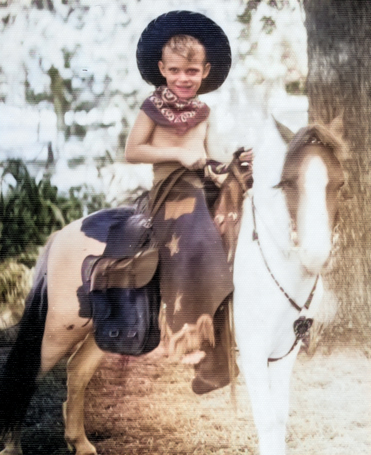
50s radio afternoons box tops and action heroes framed childhood memories
Many elements of small-town theater attendance were unique to the 50s. The emergence of tv and the movie industry development during the next two decades changed attendance patterns, economics, and the content of presentations. Many of my favorite childhood movies were released in 1951. Big screens, stereo sound, big budgets, and expensive sets emerged from the lull in production during WWII. Science Fiction and History themes changed the storylines from the Cowboy Western dominance of the 40s. The average ticket price in 1951 was $0.47, adjusted for inflation this would be equivalent to $4.53 in 2020. The top-grossing movie of the year, Quo Vadis, was so successful that it saved the MGM Studios from bankruptcy.
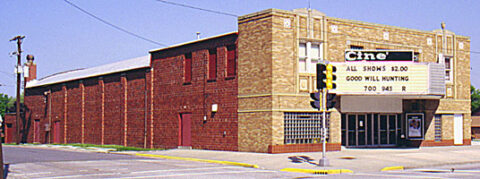
Roxana Illinois movie theater frames childhood
fantasies and friendships in the 40s and 50s
Photo by Rodger 1998
The Saturday theater programs in the 50s included double features and cartoon marathons. The theater was 3 blocks from my house. I began walking there to see movies by myself by age 7. The owners of the theater in Roxana, Illinois were very strict managers and maintained an orderly and clean environment. They allowed children to stay in the theater and watch double features twice without paying for the second show. I often watched movies for 5 hours. The price of a child’s ticket, $.25, did not restrict my ability to go anytime there was a movie of interest. For some families, theater attendance was a special occasion. It was common for children’s birthday parties to include a trip to the theater.
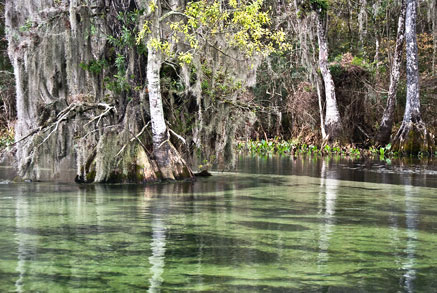
Wakulla Springs Florida scene for Tarzan movies
The menu of movies produced in 1951 included a large percentage of Westerns, Comedy, and animated shorts (cartoons). All of this appealed to children. Most of the theater programs, the combination of movies being presented, ran for a week. The audience was a mix of children and adults. The weekly presentations alternated classic movies, such as the 1938 version of Robin Hood, with current releases. Attendance with friends was common and ad hoc, I sometimes noticed a friend walking to the theater or in the audience as I entered the auditorium. The emergence of action heroes such as Tarzan was rapidly evolving.
The science fiction genre produced several classics in 1951, including The Thing from Another World, Them, and When Worlds Collide, still favorites 70 years later. Batman and Superman, comic book heroes, were serialized in weekly film episodes. These films were short length and preceded the main feature. The production style was modelled after the cliff hanger silent films. I enjoyed the Batman and Superman serials but was not able to attend often enough to see an entire series.
Basketball sports fan childhood memories
Watching high school basketball games took on new meaning after I started playing practice games at the Community Center at age 9. The high school players were the sports heroes for the elementary and Junior High children. We knew the player’s shots and moves. When we played on the school grounds and indoor gyms, we tried to clone our favorite players. We imitated the playing styles and techniques. Some of our attempts to take this player style imitation to another level resulted in some very strange looking basketball.
I kept a very accurate and complete box score for High School games, including the performance of each player. The game score was updated without looking at the score board. Ralph Freeman, one of my favorite players, took up a lot of my time keeping the box scores. My family kept a lot of memorabilia. I have not been able to find any of the box scores that I kept. Family memorabilia are of great value to me. They provide a tangible link that refreshes and strengthens memories.
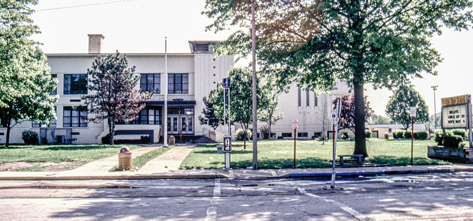
Roxana Illinois High School watching high school basketball games and Sunday afternoon practice photo by rodger
My study of the game, and my newfound insider knowledge, often resulted in conflicts with my father’s view of the game. My father’s comments about how well a guy was playing clashed with my observation that the forward I was watching had already scored 30 points and had very good technique on his jump shots. These disagreements were allowed although I rarely if ever convinced my father that his analysis of the game was not correct. In everyday life I was not allowed to disagree with my father about anything. Sports were one subject where I could express myself without fear of retribution.
50s small town basketball culture
Because of the location of the High School in a very small town, most people walked to the game. The experience was as much a neighborhood phenomenon as it was a city experience. The sensations in the foyer at the gym for basketball games are very vivid childhood memories. The smell was a unique combination of cigarette smoke, popcorn, and the cleaning oil used for the floors. The crowd building up in the gym was getting warmed up with some pregame cheerleading and the foyer was filled with the people waiting to get their tickets while discussing the prospects for the game.
I will never forget this combination of sights, sounds, and smells. This 50s childhood neighborhood routine was family, friends, community, home, and sports all wrapped up in a way that was common for the era before TV. The game was not about the commercialism of athletic gear or college scholarships. Radio and television broadcasts were not yet available. High School basketball was experienced, remembered, and discussed at the barbershop the next morning.
I was in that foyer while passing through Roxana and Highland on a business trip in 1996. The school had put all of the pictures of everyone who had graduated on the wall of the foyer. I was struck by how great that tradition was. I browsed the pictures and recognized many of my friends from elementary school even though the last year I had lived in Roxana was the 6th grade in 1955.
50s childhood sports fan neighborhood venues
In Roxana, Illinois in the 50s everyone was a Monday-morning quarterback. Although this term was defined for analysis of football by fans it also applied to analysis of basketball games. The primary meeting place for Monday-morning quarterbacks was the barbershop. Before TV, personal interactions such as analyzing the basketball game were comradery, recreation, friendship, and identity in the community. The discussion of the games could range from the strategy, such as why did they try to fast break on such small floor, to the performance of a particular player. Heroes, the high school football and basketball stars, walked the streets. They were at the theater and businesses in the very small town, so you walked past them on the street every day.
The SnakeDdance down main street after the game displayed the enthusiasm for a victory. The term describes a student parade, a line of students linked hand in hand dancing down the street and weaving around trees and parked cars. This 50s childhood neighborhood routine is a tradition that I have not heard about since I left Roxana in 1955.
50s childhood neighborhood routines toys and games
Impromptu and planned games with neighborhood children were a feature of my childhood in Roxana, Illinois beginning at age 6 or 7 years old and in Anacortes, Washington when I moved there in 1955 at age 12. The number of participants was typically from 4 to 6 with an age range of from 1 to 2 years from oldest to youngest. The neighborhood participation, not unanimous, averaged about 50%. An older age group in Roxana involved a more diverse set of games such as marbles, digging tunnels, Cowboys vs Indians and a larger group of participants.
Homemade games with minimal or imaginary props were a distinctive feature of small-town childhood culture. Peashooters, building kites, model airplanes. digging tunnels, games of marbles in the driveway, snow sledding, and Christmas tree bonfires substituted for manufactured toys. The features and landscaping of public buildings served as sets for various games involving the currently popular movie characters. Hedges against the outside of the building were a natural play forest for a 4- or 5-year-old. The steps and porches were natural mountains and fortresses. Construction sites for houses were very good playgrounds with piles of dirt and holes for the foundation that served as make believe geography.
There were several occasions when I suddenly discovered a sport or game that generated immediate excitement and became my favorite. I discovered badminton at the recreation center during the summer at age 8. For the next several weeks I was absorbed by the game and wanted to play all day every day. The fundamentals of the game matched the natural urge to run and swing the racket at the shuttlecock. I discovered croquet at a church social at age 5. I did not have a set at home. Whenever I was at a friend or relatives house that had a set, I always asked to set up the game.
Gym rats and comic book collectors childhood neighborhood routines
The Sunday afternoon basketball routine in 1954 was the most anticipated and enjoyable event of my young life. The janitor at the high school, Vince, was a church member and family friend. His son played basketball. He let a small group of friends into the gym every Sunday. The gym was well known to me by then, I had been attending high school games from age 4. Playing on the same floor as my high school heroes was a thrill. I played 2 or 3 person games with my father and friends and used the space to practice ball handling and shooting. Children who were always in the gym, even when it was locked and supposedly closed, were called gym rats. You did not know how they got in or how to get them out.
The trading comic books routine was pervasive in 50s culture. Exchanging comic books with friends enabled the reading habit without having to constantly buy new books. My parents did not provide money for toys except sports equipment. They did allow the purchase of a small quantity of comic books. I read comic books almost every day for several years from age 7. If I did not have a ball game going on at school, I would run home at lunch time and read during lunch break. My favorite characters were Batman, Aquaman, Green Arrow, and Superman. I started reading science fiction novels in Junior High School. My homework and study habits were not great, but my reading habits resulted in a very high verbal SAT score.
Climbing and running were simple universal 50s childhood routines
Climbing trees was a universal play activity. Children built tree houses in private and publicly owned trees. I remember a treehouse on a vacant lot on the North side of 4th street that had wooden ladder rungs nailed into the tree trunk. The primal urge to climb and run shaped an 8-year old’s world view. Children scoped the trees that they planned to climb and the method of getting to the lowest limb on routine walking trips. Broken arms were more common than legs. I don’t remember any fatalities or hospital stays. Casts were a common sight for boys and girls.
Red Rover was one of my favorite chasing games. Impromptu rules for chasing games were made up at the location. Before children were old enough to have an interest in basketball, they would organize chasing games outside during the game.
The 50s childhood neighborhood routines for climbing and frequent broken bones reflects a different approach toward children and physical risk. An attitude shift that began about 1980, created a much more safety conscious and protective philosophy for children. In the days of agriculture and work in industry that was physically intensive, my family accepted scrapes, cuts, broken bones, etc. as part of growing up and daily routines. Medical care was less sophisticated but also much less expensive and nobody got sued for children falling out of trees or off of fences. Drs took several x-rays and manipulated the arm in between x-rays to get the bones lined up. The procedure was a time consuming and painful process that I did not experience but was recounted to me by friends.
50s childhood routines with extended family
Routines for extended family gatherings were frequent, scheduled, and ad hoc. Aunts’ uncles and cousins from my mother’s family lived within a few blocks. My father’s family, grandparents, aunts, uncles, and cousins were in Highland, Illinois about 25 miles from Roxana. Sundays were for dinners and social, meaning work or sports related news updates. Ad hoc gatherings were often for playing card games or board games, or for my grandparents’ house for homemade ice cream.
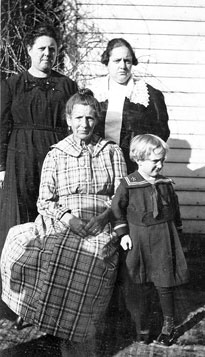
Coal miners’ daughters 1925, Grandmother Eliza back left daughter Elsie, mother, and granddaughter photo edit by rodger
The family relationships were much more than, sons, daughters, parents or cousins. Working class roots, family history from Illinois statehood in 1818 through WWII, and the challenges of droughts, depressions, and pandemics created threads of character and a unique cultural identity.
I am the son, grandson, and great grandson of coal miners’ daughters. Oswald Kile, my great grandfather fought for General Grant in the Civil War. Uncle Harry Kelley fought in the trenches in France n WWI. Uncle Fred Immer flew B24 missions over Germany in WWII, when the casualty rates for some battalions was 50%. My father fought at the battles of Peleliu and the Philippine Sea. Peleliu had the highest casualty rate of any battle for the Pacific war. My uncle Louis Warford had taken in two orphans, my mother’s parents died when she was 10 and my cousin’s mother died when she was 11 and raised them from childhood through high school.
Working together on a farm or coal mines and surviving wars and depressions as a family, not government assistance, created strong multigenerational family ties. Throughout my childhood and adult life, I have always felt the presence and support of the extended family. My personal mission has been to live up to that character expressed over generations.
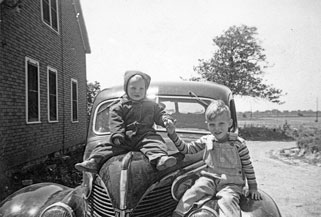
Grandmother’s cooking and family gatherings childhood memories
1951 photo edit by rodger
Home cooked meals and desserts were indispensable elements of extended family routines. Aunt Myrtle, a substitute grandmother, cooked one of my lifetime favorite dinners, creamed peas and fried chicken. Grandmother Cuma presented surprise desserts that stand out over generations of home cooked and restaurant meals. Her advantage was fresh strawberries from the garden that day, fresh cream from the cow that day, and fresh baked shortcake. My cousin Tyke knew my favorite dessert, tapioca, and often prepared it for my visits. The home cooked meals were a routine that enhanced the experience of home. There is no place like home especially at the end of a dirt road on the edge of a hardwood forest at the peak of fall colors.
50s childhood routines downtown
The Sweet Shop, the name given to the small restaurant down the street, had Lemon Phosphates and Cherry Cokes, all the candy you could ever want, and drugstore cowboys. Soda fountains achieved icon status for popularity as hangouts for both adults and children. They are an essential part of my 50s memory.
I only had one Cherry Coke that I remember. My father grew up on a farm on the Colorado plains. He viewed Cherry Cokes as wasteful and unhealthy. We never had soft drinks in the house and never ordered them at restaurants. I often saw soda fountains at stores and would have been a consumer except for the parental prohibition.

Vasquez Rocks site for hundreds of films from the early 1900s 21st century childhood memories for rock climbers photo 2024 by rodger
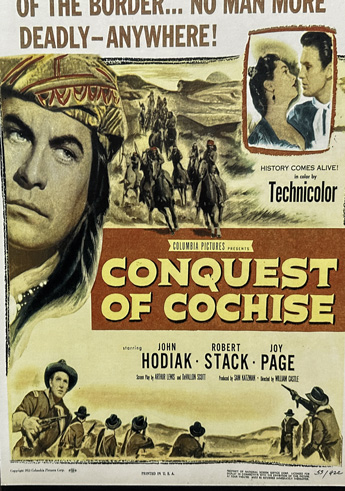
Cowboys and Indians themes dominated Film and Tv in the 50s
The western movie cowboy culture morphed many elements of 50s life, including the soda fountains. Many children and young adults wore cowboy hats and boots when they hung out at soda fountains. The image distinguished them as being cool, hip, or in some other way connected to the cowboy image. For them, the cowboy clothes were a style that suited the pop culture of the 50s. The local agriculture was dairy farming. My relatives who lived on dairy farms did not wear cowboy hats or boots. They interpreted the drugstore cowboys as singing cowboy wannabes whose clothes never looked worn or dirty. My Colorado plains relatives wore hats and boots. The got dirt on their boots. Western Movies were a dominant theme in 50s small town traditions. Ad hoc movie attendance and Saturday morning children’s Tv routines were pervasive American culture as well as Europe where bored employees would tie each other up with ropes to test a friend’s ability to escape.
Eating dinner at a restaurant was a rare event for my extended family. The two restaurants in Roxana had very limited menus and seating for less than 20 people. During my infrequent restaurant visits I quickly identified my favorite meal. I liked hot roast beef with potatoes and gravy, served open faced with gravy on the bread and potatoes. The price was $.75 in 1950, equivalent to about $12 2020 dollars. This is still one of my favorite meal’s decades later. I don’t see this item on menus anymore.
Drug stores were much smaller and had fewer items in comparison to the Rite Aid and other chains that covered the country in the 1980s. The drug store in Roxana was not much larger than a small basement. It did have popsicles. You could break them in half and buy half for 2 cents. I did not have an allowance or spend money on candy but could often find 2 cents for a popsicle.
The barber shop and post office have local news updates
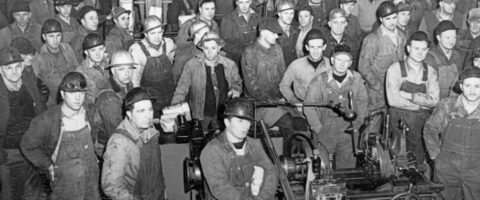
Roxan Illinois Shell Oil Co pipe shop employees 1950 photo by rodger
The town social network hub was Radcliffe’s barber shop. The translation and application from news sources to local interests took place while waiting for your turn to get a haircut or a shave. Before TV the sources for news were the local newspaper, the Alton Evening Telegraph, the newsreels produced weekly to run with the theatrical presentation, and conversations at work or union meetings. Local sports were a frequent topic during season. The shop had two chairs for barbers and waiting for 6 customers. My father objected to my long curly hair when returned home from WWII and I received my first haircut at age 3.
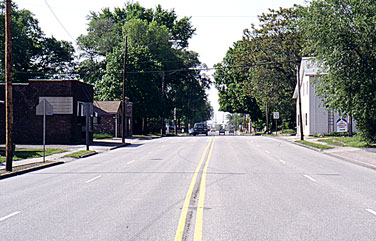
Main street Roxana, Illinois a sparse shopping district for out daily commerce barber shop brick building on left drug store on the right Photo by Rodger 1998.
Roxana did not have mail delivery. Everyone had an individual mailbox at the post office. A postcard, with the recipient address on the front and the message on the back cost one penny. The first mail that I composed and sent was penny postcards to my friends in Roxana after I had moved to Washington State. The walk to the post office and conversations at the mailboxes while picking up mail were part of the local news network. During WWII the conversations focused on the battles and location of husbands and children.
50s childhood routines at school and church
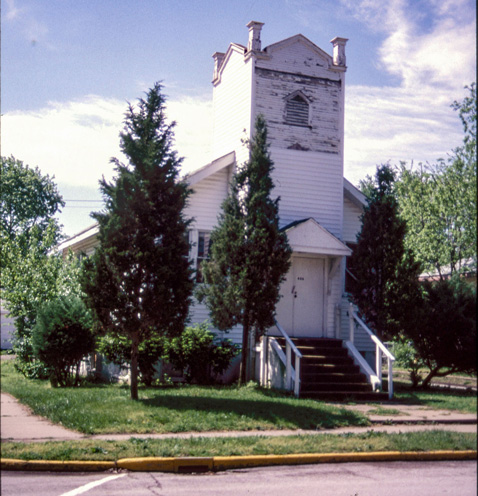
Church near our Roxana home hosted weekly services and socials photo by rodger 1998
The Church, in Wood River, Illinois about 1 mile from my home, hosted services and extended family routines from my birth in 1943 until my father was transferred from Illinois to Washington in 1955. My grandfather, the pastor, and uncle preached, and my aunt played the piano. We rarely missed Sunday service and often attended Wednesday evenings. Lunch often extended the Sunday family gathering at my grandmother’s house on the family farm about 25 miles from the church at Highland, Illinois. The church was less than a mile from my house and felt like part of the neighborhood, even though we usually drove a car.
The church location provided opportunities for expression of the family ice cream theme. Dairy farmers, including my father’s family, and the hot summers were a combination that enhanced our awareness of ice cream opportunities. We sometimes went to the Carnation plant one block south of the church on Wednesday evenings. The plant was not a retail outlet, but they served ice cream cones. There was an ice cream retail store 2 blocks west of the church.
The small congregation, Sunday attendance was never more than 100, organized a variety of social events. Events occurred before and after services, on holidays at church, and at the homes of members. Box lunch fundraiser raffles, Easter egg hunts, picnics, and barbeques provided recreation and enhanced relationships. Volleyball and softball were standard activities for outdoor events. Many of these events are vivid forever memories. The extensive matrix of relationships formed an emotional development and support system for children and adults. The experience compensated for my imperfect nuclear family. My appreciation and thankfulness continue to grow.
My earliest recollection of Oreo cookies is the morning snack for elementary school. Two cookies and a pint of milk were provided by the school. The teacher selected a student to pass out the cookies. If there was an odd number of cookies the selected student got the extra cookie. Some students brought a snack from home at the request of the parent to ensure a more nutritious snack. Children eagerly anticipated this routine. I still like Oreo cookies decades later.
50s childhood neighborhood routines at the community center
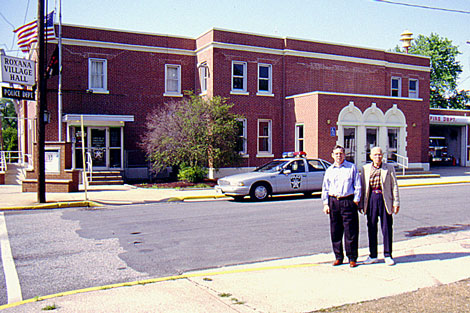
Community Center 50s favorite hangout basketball skills trampoline acrobatics and books Rodger and father photo by rodger 1998
The Community Center was on Central Ave one half block from my house. The building housed, the library, city offices, including the fire department, a gymnasium, which functioned as a theater, a basketball court, and a preschool. A kitchen and stage provided for city meetings, clubs, and theatrical presentations. Because it was next door, I began to use the facilities unattended by age 5. The variety of routines included daily and ad hoc schedules. This facility enabled multiple simultaneous children’s habitats for several age groups. The facility, and location, created a one-of-a-kind small-town experience.
My father completed a commercial pilots license when I was 4. The family airplane flights and the movies about the WWII air war created an intense interest in the fighter aircraft. The first book I remember reading was specifications for fighter aircraft. I reread them until I memorized the weapons systems and performance characteristics for all of the planes by age 8.
My father had seen these planes fly when he was in Hawaii during the war and described them in our routines for bedtime stories. My father brought home his service records and other memorabilia, including the engine plate for a Pratt & Whitney R-2800-10 engine. This engine produced 2800 horsepower compared to 1000 horsepower for the Japanese Zero. The Zero was the best performing fighter at the beginning of the war. At end of the war, it was the was the worst. During the battle of the Philippine Sea the American Hellcat, powered by this engine, had a kill ratio of 10 to 1 over the Zero. I have this engine plate in my desk drawer 80 years later.
For elementary and Junior High School Children the basketball court and trampoline routines were the star attractions. Trampoline were a very popular TV attraction in the early 50s. The children keyed on the stunts they saw on TV and enhanced them. Stunts often involved coordination between two children. The children could duplicate the impressive moves of advanced gymnasts. I was more interested in basketball and did not spend much time on the trampoline. Basketball became my favorite sport. The hours and years of practice in the Community Center gym prepared me for participation on school teams. Because of my early work on basketball skills, I played on the Junior High team while in the 6th grade.
Creative children invent routines across space and time
My aunt Erma moved, with her husband Virgil, from Colorado to San Francisco during WWII to find work. Because the country was still in recession, and everyone was adjusting to shortages, including housing, she lived with friends and slept on the kitchen floor until they found housing some months later.
Her two daughters adjusted to the absence of recreation opportunities in their very hilly and densely populated neighborhood. Roller skates were expensive and unavailable. In order to fill the recreation void, the girls created an opportunity for play. They waxed squares of cardboard large enough to sit on and slid down the steep sidewalks. When Erma found out that the slippery sidewalks were causing accidents for pedestrians, she terminated the cardboard sliding routine.
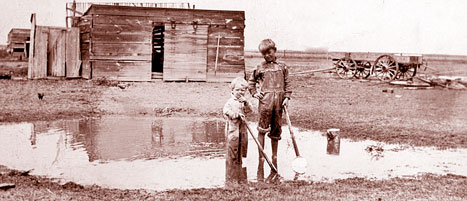
Father and uncle Eastern Colorado plains 1925
photo edit by rodger
My father’s childhood during the 1920s on the Eastern Colorado plains was several miles from the nearest town. There was no electricity, no neighbors, and no siblings until he was 5.
Children reinterpreted the prairie habitat for playful routines. The plains winds were persistent and forceful. The prairie was flat, featureless with no trees and minimal vegetation, and essentially infinite from a 4-foot tall 7-year-old child’s perspective. A worn-out bed sheet and some leftover lumber became a sail. As a result, a coaster wagon became a vehicle for exploring this never-ending highway. Because of this element of childhood creativity, sailing the coaster wagon was faster than walking and created the sensation of navigating a ship. My father never described details for these tips to imaginary destinations. He had never been to a movie, television and radio did not yet exist, and there was no library of books for bedtime stories that would have provided a reference for sailing adventures.