Vivid memories of my 50s neighborhood included physical and emotional factors. My tiny house with its proximity to locations in a walking town defined a sense of place. Bare necessities like small rooms and an unfinished concrete floor left us far behind the keep up with your neighbor’s culture. Frequent extended family interactions and devoted parents created a forever home. The situation never dimmed my neighborhood tiny house memories.
History and geography shaped 50s family culture
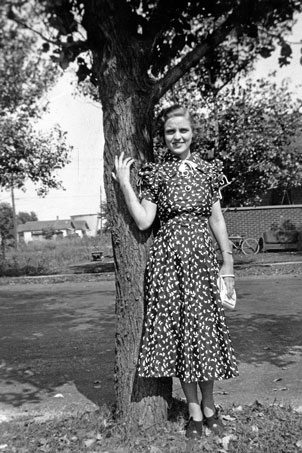
Mary Helen Smith 1935 High School graduate mother in a tiny house in 1947
My parents’ childhood, both born in 1917 in different parts of the country, created a unique blend of two distinct but iconic cultures, dairy farming and coal mining. My mother’s parents died when she was 10. In 1927 she moved to Illinois to live with her older sister Myrtle. Her family was from Higbee, Missouri. She was a coal miner’s daughter.
My father’s family was from Highland, Illinois but he had lived most of his life in Colorado and Independence, Missouri. His family moved from Independence back to Highland in 1937. At that time my grandfather was 47 and was returning to a farm where he was born in 1890. The two diverse cultures were melded together with the marriage of my parents in 1940. Cousins, aunts, and uncles’ visits on a short walk powered tiny house neighborhood memories.
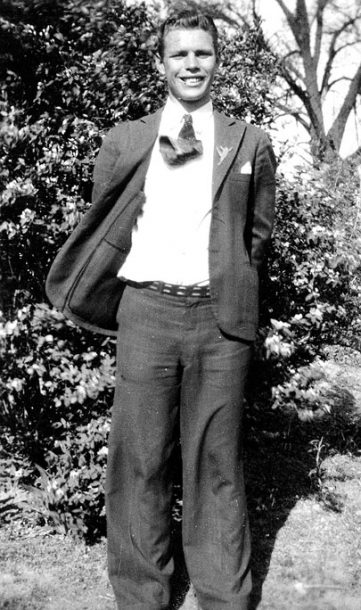
Clifford Immer Best generation high school graduate married Mary Helen Smith 1940
My parents were attending the same church in Alton, Illinois when they met in 1938. My mother, Mary Helen Smith, had graduated from Wood River High School, about 2 miles from the house, in Roxana, Illinois where we later lived, on 3rd street in 1935. She lived in Roxana, Illinois but Roxana did not yet have a high school. My father served two stints in the public works program, the CCC. He worked some short-term jobs but was unemployed most of the time from his graduation in 1935. He started a job at Shell Oil Company in Roxana in 1940. My parents married in December 1940. They rented a house in Roxana until my father entered service in WWII in November 1943. My father returned from the war in 1945 and began construction on a house in 1946.
50s neighborhood tiny house memories
During the 8 years that I lived in the tiny house I never thought about my childhood home being smaller than our neighbors. Neighborhoods constructed near my house, in the 20s and 30s, averaged about 900 square feet. My uncle, Louis Warford, gave the lot for our house as a wedding gift. Materials to build the house cost $1200. The house did not meet the standards of subsequent generations. The concrete block house was 30×15 feet. It had water and electricity but no central heating system. My father painted the floor and put down a couple of small rugs. Otherwise, it was just finished concrete.
I am not sure why my parents decided to build and live in such a small house. Economically we were not worse off than our neighbors but we had a much smaller house. My dad had been living in barracks for much of the previous several years in the CCC camps and the navy which influenced his attitude toward housing standards.
The attitude was very conservative about housing expense. The depression was still ongoing. The attitude toward debt was simple, you should not have any debt. Anyone contemplating debt for any reason would get a lot of advice from family and friends to avoid it. The interest rate at that time was 3%. This rate was considered to be crushing and would cause financial hardship for anyone who had to pay it. Several years later, after my dad had been promoted to supervisor and was making more money, my parents did buy a new and more modern house in a new suburb in East Alton. The house on 3rd street, my first house, will always be my neighborhood tiny house memories.
Furniture and affluent neighborhoods don’t make memories
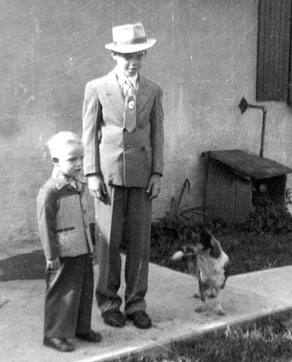
1953 tiny house family members including Tyke my dog
Roxana was about 2200 residents when I lived there. The two oil refineries, Shell on the East 1 block from my house and Standard on the west 1 block from my house sandwiched Roxan in between them. As of my last visit, in 2011, the population was 1600. The Standard Oil Refinery had closed, and the economy of the area had shrunk in the decades since I lived there. The area had been very heavily industrialized until then. Shell Oil employed about 3000 people and Standard Oil more than that. When I was born, we lived on 4th street in a rented house. Beyond the oil refineries, agriculture started about 2 miles away and extended for hundreds of miles in all directions.
My neighborhood tiny house memories included a small oil stove in a corner of the living room, at the other end of the house from my bedroom, that was the only source of heat. My bedroom was quite cold at night during the winter after the heat was turned off.
Although St Louis weather is fairly mild it can be 0 degrees for a week or two. My bedroom was below freezing at night. The solution to the cold was long underwear, which almost everyone used, and a very thick homemade quilt. I don’t remember ever feeling cold except in the morning when we got up to get dressed. We always went to the stove in the living room to get dressed in the winter. The experience of cold winters, a thick quilt, and the oil stove combined to form a warm blanket memory. From an 8-year-old and a retro adult perspective 70 years later my home was perfect.
Waking up to a very cold room is a distinct sensation that lives in my neighborhood tiny house memories. My mother was my alarm clock. When she came to wake me up in the morning for school, she always greeted me with the expression, “it is a beautiful day outside”. Whether by this childhood experience or my particular biology, I have become accustomed to sleeping in a cold room and usually adjust the heat and bedding in the room that I sleep in to be comfortable for me but uncomfortable for most other people. I often think of my mom waking me up to a cold room when I feel the cold blankets as I am getting into bed a night.
Surviving Saint Louis weather in a tiny house
There was no air conditioning, and the house was not insulated. Only commercial buildings were air conditioned. I was born in the hot humid climate, which provided some unique memories. During hot spells we sometimes slept in the front yard on blankets. I can remember noticing that the thermometer in the house read 98 on a particularly hot day. My parents claimed that there were some days when the low temperature was 100. The temperature records I reviewed don’t confirm that.
My father changed to a lighter diet with less meat and less high calorie food during the summer. Steam pipes surrounded the areas where he worked in the refinery. The temperature in the refinery under the steam pipes where he worked was well over 100 degrees. My mother used plastic coverings for the bed pillows. Maybe it was because the cloth covers would become so wet with sweat. The routine with the plastic pillows was to turn them every half hour. That way you got the cool side next to your face for a few minutes until body temperature heated it up. The hot summer nights characterize my neighborhood tiny house memories.
Our 50s tiny house lagged behind the Joneses
The only door inside the house on 3rd street was for the bathroom. There was a curtain in the doorway to my parent’s bedroom. The very small living space and the absence of doors was a problem for my father’s work schedule. When he worked the midnight shift, I had to be very quiet, or at least I was supposed to. My dad did not like working nights and having a small child in the house did not help. I am sure I was much quieter than the average 4-year-old.
There was no bathtub in the house on 3rd street and I always felt deprived. My aunt Myrtle, my mother’s older sister, did have a bathtub at her house in Wood River less than 1 mile from our house in Roxana. Often, when we visited, I would spend my time in the bathtub with whatever toys were left over from my older cousins.

My mother’s childhood home with her sister and brother in law photo by rodger 1998
My aunt Myrtle had a two-story house with a basement and an enclosed sun porch. A coal fired boiler in the basement heated her house with steam. Keeping the furnace stoked with coal and the ashes cleaned out was a daily task but the system provided heat to a radiator in each room. A valve on the radiator in the room regulated heat by allowing more circulation of steam through the pipes in the radiator. Most of the houses built in the 20s and 30s used the standard coal fired heating system. A large room in the basement held the coal supply for the winter. Families with a steam heating system purchased their coal supply each fall. A truck with a chute would dump the coal in through a basement window.
The house on 3rd street ultimately got some improvements but of course was never larger than 450 square feet. We moved out of the house to a new one in Rosewood Heights about 3 miles away in 1954 so I lived on 3rd street for about 8 years
Home is more than a memory of buildings and trees
The completion of the house in 1947 was cause for a celebration by family and friends. We had a housewarming of sorts. I was 4 years old. The only memories of the construction are climbing around in the rafters when my father was finishing the electrical. There was no mortgage payment it was all ours.
We had two fires inside the house that did minor damage during the 8 years that I lived there. Oil-soaked clothes hung too close to a little oil heater in the utility room caused the first fire. The fire department quickly responded since the station was only a few yards away across the street. They quickly put out the fire and limited the damage to one corner of the house. I was still in my long underwear since the fire was early in the morning. I wore my long underwear until the fire was put out. The fire station next door and the firemen arriving to put out the fire are prominent in my neighborhood tiny house memories.
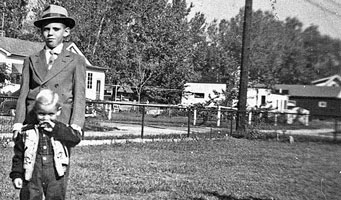
Roxana Illinois 3rd St front yard vacant lots down the alley next to the grocery store
My father designed the house with only one bedroom. I never understood why. When my parents moved into the house, they had one child and planned for more. I was sleeping in an iron framed crib in the one bedroom when we moved into the new house. Within a year my father had converted the garage into a bedroom. My father sealed the garage door and purchased a bed for me. The garage bedroom was mine until my brother, born in 1949, turned 4 years old. My brother moved into the garage bedroom, and we used bunk beds until we moved to a new house in 1954.
The garage bedroom became the tv room a year after my father purchased our first tv in 1951. The room was large enough for one or two chairs. Everyone else sat on the bed to watch tv. There were several childhood favorite programs that became lifetime memories. Ozzie and Harriet, George Burns and Gracie Allen, and Cowboy Stars were favorites that I looked forward to every week. I watched Tom Corbett Space Cadett for several years. Some of the tv shows, for e.g., Tom Corbett, ran on irregular schedules. Episodes were twice weekly and varied in length. Episodes were either 15 minutes or one-half hour. Most of all I remember a series, I Remember Mama about a family in 1910 San Francisco. Follow the links for Wikipedia articles.
The tv series Mama always started with a flash forward to daughter Katrina Hansen paging through a family photo album of life in 1910 San Francisco: remembering San Francisco, the house where she was born, cousins, aunts and uncles, the boys and girls she grew up with, her family as they were, and most of all she remembered Mama. So let it be with Roxana, Illinois in the 1950s. When I look back to those days so long ago, most of all, I remember … Mama.
Mosquitos everywhere and they are big enough to carry you away