Cornfields dotted much of the Southern Illinois landscape in the 1950s. During the growing season adjacent fields created the appearance of a small scale tropical forest.
I had travelled the route East along Illinois HWY 143 and Route 66 through the corn fields many times. On a trip late in the 1951 growing season the corn was tasseling and at it’s peak height of about 10 feet. From an 8 year old’s perspective, who is only about half as tall as the corn, this is a miniature tropical forest that must be explored. The field at my grandparents farm was about 100 acres in size on the Western side bordering on Prairie Road. The temperature was typically above 90 degrees and sometimes over 100 degrees. The humidity was often over 80%.
A vague sense of adventure inspires an 8 year old
Corn was a common crop for dairy farms in 1950s Illinois. Yields could be 100 bushels per acre or more. The market price was approximately $1 per bushel in 1951. The cash from the crop sale would be much greater than the average yearly household income in the United States at that time.
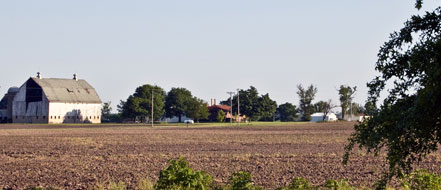
Field on Deck’s Prairie farm. View to the
Northwest across Prairie Rd to adjacent farm.
Photo 2007 by Rodger
An 8 year old perspective of a corn field is not based on economics. A few feet inside a corn field is like being in a very strange jungle. The corn stalks create a green tinted light. The corn leaves block most of the sunlight from the view of a child under five feet tall. The humidity and temperature rival a tropical jungle. In 1954, the last year that I lived a few miles from this field, there was a record 117 degree day.
Corn field solitude
The maze of green leaves and stalks obscures rows a feet away. There is a sense of direction because the orientation of the rows is visible. Distance farther that a few feet away is distorted. Every place you stand inside the corn field looks exactly the same. Walking a few feet or a half mile does not give any sense of how far you have traveled. There is no fear of getting lost because the rows were plowed very precisely. If you follow the rows you will eventually leave the field.
Sounds become muffled.The absence of any sound except the rustling of the leaves adds to the detachment. The feeling is that you are alone in a very different kind of place. In 1951 jet air travel had not yet established its noise print on the planet and automobile traffic was very light. The sensory environment creates a strange and intense feeling of finding solitude.
Corn field solitude revisited
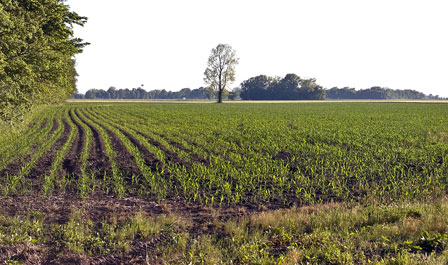
Corn field in Western Kentucky early in the season 2007.
Photo by Rodger.
On my visits to the Illinois farm in the 70s, 80s, and 90s, I always went for a short walk in the field. I was never able to time my adult trips to the growing season. I did not see the corn when it was maximum height and tasseling. Walking a corn field just before harvest is still on my list of things to do. On my trip to the Midwest in 2007 I crossed Southern Kentucky into Southern Illinois. I stopped to go for a walk in one of the corn fields. Because the growing season had just started the corn was only about a foot high. The Kentucky fields are much larger than the fields that I saw in Highland, Illinois.
Castles in the air and adventure around the corner
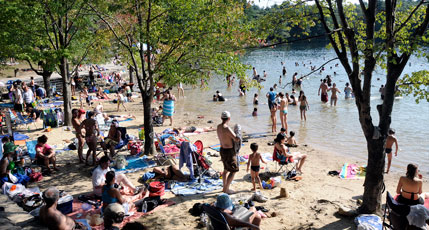
Walden Pond in 2009 is not the island of solitude that
Henry David Thoreau saw for 2 years 2 months and 2 days.
Photo by Rodger 2009
Finding solitude is an individual experience. Henry David Thoreau wrote this to express his experience living at Walden Pond for 2 years, 2 months, and 2 days in 1854: “If you have built castles in the air, your work need not be lost; that is where they should be. Now put the foundations under them”. In 1854 Walden Pond was, as Thoreau described it, free from the distractions of civilization.
The beauty of a field road in fall colors, the solitude of a corn field, or a building portico where a 5 year old can jump out over a hedge with a batman cape on and pretend to be an action hero, are locations for castles in the air. Theodore Roosevelt’s wilderness preservation initiatives, the recreation movements, city park development and open space preservation are all connected to a yearning for the locations where castles in the air can be constructed. When I took this photograph at Walden Pond in 2009 it took 30 minutes just to get into the parking lot. The crowded beach left little space to put a blanket down.
Paradise lost and found
This corn field experience is an example of a place for finding solitude. There is a sense of isolation and sensual deprivation. The very peculiar and unique environment of sight and sound creates a unique sense of place, a strange private world of green, heat, humidity, and fantasy. The ongoing path of civilization may result in some paradise being lost. National Parks are becoming more crowded. On a busy holiday weekend it may take several hours just to get out of the city you live in.