Macoupin Creek, in Woodville Township, Illinois, ends at the Illinois River near Hardin. The Illinois River ends, about 20 miles from Hardin, at the Mississippi River near Grafton, Illinois. The fishing cabin my uncle rented at the Illinois River levee was 100 yards from the end of Macoupin creek. The mosquitos 50s childhood memories and the hot weather and mosquito combination elicit a sense of place and time. Adults and children were sensitive to the double whammy combination. Neither air conditioning nor mosquito abatement were options to mitigate the phenomenon. Discussions of the phenomenon were rare. We accepted the suffering in silence. The degrees of discomfort were variable. Individual variations of allergies and the effects of the heat determined the impact. The suffering was not equal.
A fisherman’s son and a fisherman’s nephew
I began fishing on this area of the Illinois River before I was old enough to remember it. My father was in the South Pacific serving in the Navy during WWII from the time I was age 6 months until I was almost 3 in 1945. During that time I lived at my mother’s brother in law’s house with my uncle Louis and his family. My uncle had moved from Higbee, Missouri to Illinois about 20 years earlier to work for Shell Oil Co. The Illinois River fishing and hunting was a big improvement over Higbee where there were only very small creeks to fish in. He often took me with him on fishing trips from age 2 until we moved to Washington State in 1955 when I was 12.
This is an image of Macoupin Creek. The farmland and country side pulls me back. Rural, down home, serene, and many other adjectives apply to these scenes. I was at this location in 1998. The cabin was still there and the scene was little changed from the 1940s. The creek was much larger and deeper where it merged with the Illinois River.
Sparse accommodations reinforced mosquitos 50s childhood memories
The cabin that my uncle rented for our week end stays was only two rooms, a kitchen – dining room and a bedroom. The stove was very primitive and dangerous to operate. It was gasoline, like the gasoline in your car, difficult to light without creating a minor explosion, and difficult to cook with. This tiny cabin seemed to somehow work out whether there were 3 or 20 people staying there.
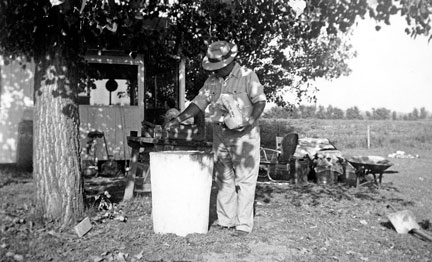
Uncle Louis cleaning fish at Illinois River cabin near Hardin 1949.
Substitute father during WWII, best friend, and dedicated fisherman.
Photo edit by Rodger 2007.
There was one particularly memorable family gathering, in 1949 I think, with two of my mothers siblings, her sister Myrtle and brother David’s families at my uncle Louis’s fishing cabin. Alice Jean, David’s oldest daughter, involved me in a scheme to make a present that I could give to my mother. We collected shells from the sandy banks washed up against the levee of the Illinois River. She said she would make the shells into a necklace. I received one letter from Alice Jean about the progress of the necklace. However, it was never finished.
Swimming in mud puddles mosquitos 50s childhood memories
There was a section of Macoupin creek where we swam. There was no beach just the mud from the delta of the creek and water so murky that you could not see the bottom in one foot of water. The heat and humidity of the Mississippi River valley made any water that was cooler than the 100 degree air temperature a good place to go swimming. I am sure we ate fish for some of our meals at that reunion but I don’t remember doing any fishing on that trip.
Kerosene is the secret to a good night’s sleep
In 1949 mosquito abatement and the use of DDT had not yet impacted the infestation that we experienced every summer. We swatted mosquitoes as a daily routine. Mosquito bites were a visible and uncomfortable reminder of the pests. Prime swampy mosquito habitat surrounded the cabin at the river. We used a common household chemical, kerosene, to temporarily rid the bedroom of mosquitoes and get some sleep at night. A garden sprayer fogged the air with kerosene. This got rid of the mosquitoes for a few hours so we could sleep. Of course kerosene is toxic but some would settle out of the air after an hour or so and we would be free of mosquitoes for a few hours. Mosquitos were prominent in the 50s childhood memories to identify places like swamps and stagnant bodies of water that were perfect habitats for the pests.
Fishing was an American pastime and family culture
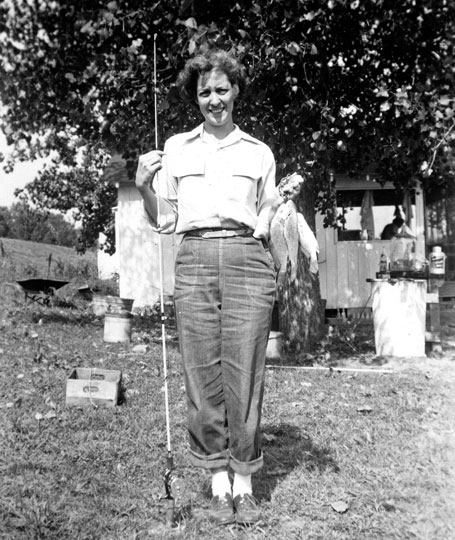
Cousin Tyke at the Illinois River fishing cabin 1948. Orphan, loving and dearest cousin, and best friend. Photo edit by Rodger
My uncle was taking care of two orphans from 1927 until 1940. The orphans participated in the fishing culture. The woman in the picture is Tyke Kelso. The catch displayed is typical for this area where we fished in the creek and the Illinois River. We caught and ate Bluegill, Crappie, and Sunfish in the creek and Catfish and Carp in the Illinois River. I referred to my cousin Tyke as my aunt because of the age difference. She was a dear friend and added to the family experience at the river.
My dad was a very serious fisherman.He grew up on the plains of Eastern Colorado where there was no place to fish. He moved to Independence, Missouri then later to Highland, Illinois in 1937. My father moved to Roxana, Illinois in 1940. Roxana is near the Missouri, Mississippi, and Illinois Rivers and many lakes.
Fishing was a prime activity for vacations
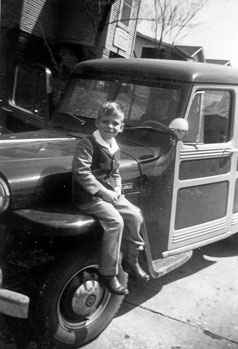
Willis Jeep first car 1948. Transport
to church and grandmother’s house.
Photo edit by Rodger 2007.
My father bought a Willys Jeep in 1948. It was kind of an early version of an SUV but quite small. We used the Jeep for a fishing trip to Minnesota. I am not sure why we were sleeping in the back of the Jeep except that the mosquitoes were numerous and ferocious. My mom and dad took turns staying awake to keep the mosquitoes off of us so we could sleep. Mosquitos 50s childhood memories underline the trip experience. We were staying on a lake that I can remember quite vividly from the experience at age 5. Mosquitos were a major component of 50s childhood memories that defined a sense of place.
Rodger age 5 at Minnesota lake 1948. Vacation trips
were motivated by the fisherman family culture.
Photo edit by Rodger .
The lake was quite clear and I remember fishing from a dock. You could watch the fish take the bait and bite the hook. This fishing was just for fun since the fish I was catching off of the dock were quite small we released all of them back. Some of the fish had been caught several times and had learned to recognize the bait and hook. I would watch them swim up to the hook and then back off.
This event underlines the fishing element of family culture. Many of our family vacations were fishing trips. My mother’s brother in law, Louis Warford was even more of a fisherman than my dad. He fished in almost any puddle or trickle of water.