Swimming was a recreational activity but was also an escape from the heat. We swam in almost every mud puddle that was at least 6 feet deep. People engaged in compulsive swimming as a common adaptation. The culture for the place and time included compulsive swimming.
The summer weather near St Louis Missouri was like a tropical forest
The additional description to finish the above statement is: except worse. Before air conditioning, people who knew the weather in this area of the Mississippi River valley described it as like Hell, unbearably hot. The high temperature in 1954, the last summer that I lived there, was 117 degrees. The humidity rivaled a tropical forest and was often above 90%. My family lived in this area since the early 1800s.
My ancestors milked cows and harvested crops regardless of the weather. They noted the unusually hot days, above 100 degrees, in conversation. They did not engage in lengthy discussions and complaints. The only mitigation of the heat was shade trees, if you had planted them. I have read that human physiology will adapt to climate over a period of years. If that is true, the long term residents may have benefited from an adaptation. My family moved to Washington State in 1955 and I never experienced another summer like the St Louis area. In retrospect, I can’t imagine anyone surviving those summers.
Compulsive swimming was a substitute for air conditioning
I can remember the first time that I experienced an air conditioned building in 1953 very clearly. I visited a department store on a shopping trip with my mother in the neighboring town of Wood River, Illinois. The contrast with the air outside was dramatic. The public buildings in Roxana did not have air conditioning.
The heat is not a dominant element of my personal memories of this time period, 1947 to 1954, but there were some effects on our life with heat that stand out. My bedroom was a converted garage that did not have any windows that could be opened. On very hot days I sometimes slept on the couch in the living room next to a screen door. The couch was plastic and, for some reason I can not remember, the pillow cases were also plastic. After a few minutes the pillow case would become hot and slippery with sweat. I spent the night turning the pillow frequently to get the cool side for a few minutes. My father worked a changing shift schedule. When he arrived home at midnight he would often find us in the front yard sleeping on a blanket.
The adaptation to heat made use of the natural environment
My family, and many others, adjusted to the heat by spending as many hours as possible swimming. The nearest lake that had a beach and swimming facilities was Greenville Lake, about a 20 mile drive. It had a sandy beach, bath house to shower and change clothes, a wooden dock, and a diving tower. There was also a park with picnic tables and Bar-b-queues. We often drove to this lake on summer evenings.
The geography of lakes and rivers created a natural opportunity to express this form of recreation and the community pools added to the menu. The weather motivated swimming fanaticism is not something I would currently embrace. It was an essential and elemental part of my childhood experience. We lived about 20 miles from the confluence of the Mississippi, Missouri, and Illinois rivers. The topography and the 40 plus inches of rainfall created numerous lakes. The lakes served as recreation centers. The pollution in some of the small lakes and rivers that we swam in was hazardous to your health. I remember some discussion that the water was not very clean but we swam there anyway.
The surrounding agriculture provided many man made small lakes and ponds. These very small bodies of water were multipurpose. They provided water for livestock, a place to stock fish, and for swimming. They sometimes had a small boat dock so that you could dive in and swim without wading through the muddy bottom. If we came across one of these on our travels through the countryside we sometimes just parked the car and went swimming for a half hour or so. We did not know who the pond belonged to but assumed that they would not mind that we swam there. We did not identify the compulsive swimming behavior as abnormal. The life style went with the climate.
The largest swimming pool in the world
I rode my bicycle about 1 mile to the swimming pool in the neighboring town of Wood River, Illinois. Standard Oil Co. constructed this pool, the largest in the world, for their employees in 1926. The link to the Facebook page for Wood River pool . My family used this pool for recreation. Most of my trips to the pool were by myself.
Swimming paradise was about 100 miles southwest
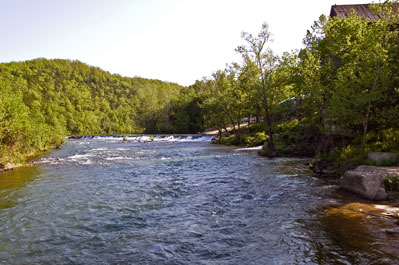
Dawt water mill on the White River near Tecumseh, Missouri.
Family vacation paradise for fishing and swimming trips.
Photo by Rodger 2007.
We often went to the Ozark Mountains in Missouri for family vacations. The Ozark National Scenic Riverways National Park, created in 1964, included the locations where we fished, swam, and hiked. The large number of springs creates lakes and rivers that are beautiful and sparkling clean. We travelled to other parts of the US for vacations but the proximity of the Ozarks made this a favorite and frequent destination.
The lakes in that area are very different from the usual image of what a swimming and fishing lake would be like. The lake we went to, near Ava, Missouri, for swimming was created by springs. The bottom was a combination of bright colored rock and sand that caused a visibility of at least 50 feet. The lake was used for recreation by area residents but the population was very small towns and farms so there never were more than 20 or 30 people there. There was a wooden platform in the middle of the lake for swimming and diving.
Childhood paradise lost and then found
In 1947 my father, his younger brother Fred, and their families travelled to the Missouri Ozarks for a camping trip. They had both served in WWII, my father in the Seabees in the South Pacific and Fred as a B24 Bomber crew member in Europe. This trip was less than 2 years after the end of the war and a celebration of return to family.
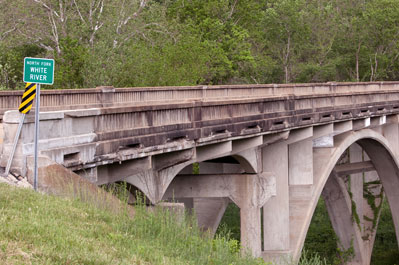
North Fork of the White River in the Missouri Ozarks. Long
lost but never forgotten location of 1947 family camping trip.
Photo by Rodger 2007.
Although I was only 4 years old I have vivid memories of the trip. We hiked for a short distance along a river and set up camp on the beach. My younger cousin Dennis was one year old and being carried by his parents. There were no State Parks and no regulations so we just put our sleeping bags down on a level sandy section of the beach. There were crayfish in the shallow pools on the edge of the river. We did not eat crayfish so they were just an ad hoc toy for a 4 year old. Canoeing and Kayaking, that became a major attraction for this river during the 70s and 80s, were decades in the future. Tubing, floating down the river on air mattresses, was common. There were some short sections of rapids to generate some excitement.
My family moved to Washington State in 1955 when I was 12. The memories of this trip never faded. I travelled to the Ozarks several times between 1970 and 2007. Attempts to find this location failed. The searches were not well organized since I did not know the name of the river. During a trip to tour the 19th century water mills in 2007 I took many pictures in this area of the Ozarks. While visiting Highland, Illinois later in this trip, I talked to my aunt Pearl about this location. She remembered that the North Fork of the White River was one of our destinations. I had finally revisited paradise after 60 years.