Before the development of the recreation movement, which did not start to accelerate until the late 50s, children adapted their environment for playful purposes. Cities did not allocate facilities for children’s programs. Cities did not budget and train staff to manage them. Children reimagined buildings and the natural landscape to serve as children’s toys.
Toy production dwindled during WWII
American industry made few toys during the war. it took awhile after the war to get the toy industry and the quantity of toys geared back up. Homemade toys from inexpensive material filled part of the gap.
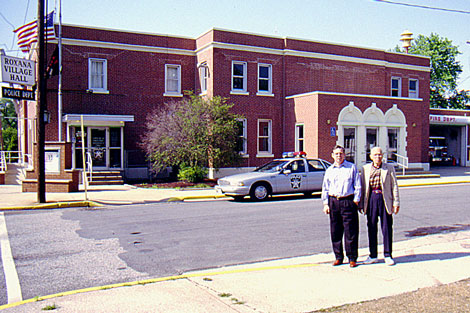
Roxana Illinois Community services building 1998. Completed in 1938 it had a basketball court Library and city offices.
Photo by Rodger 1998.
In lieu of toys that you could buy, the features and landscaping of public buildings served as sets for various games involving the currently popular movie characters. Hedges against the outside of the building were a natural play forest for a 4 or 5 year old. The steps and porches were natural mountains and fortresses. Construction sites for houses were very good playgrounds with piles of dirt and holes for the foundation that served as make believe geography. Batman and Superman, comic book heroes serialized in weekly film episodes, inspired the characters. Cowboy movie stars captured adult and child audiences.
Fantasy world props were readily available
A length of rope was a tool for action heroes and singing cowboys. Spinning a rope threaded through a loop to make a circle parallel to the ground big enough to jump in and out of was a skill that many 8 or 9 year old children mastered. The Western Movie stars of the 30s and 40s demonstrated these tricks in movies and on TV shows. Before the entertainment industry got going after the war, hundreds of Western films in studio archives provided a huge library of entertainment for early TV. The character Hopalong Cassidy appeared in 62 films. These films defined the idols, such as Roy Rodgers, Gene Autry, and Hopalong Cassidy. One of the common children’s games was to tie someone up with a rope. This event, either tying up the good guys or bad guys, was part of the action in western films.
Children’s toys were homemade
Kite flying was a popular activity. Children di not purchase kites. Kite building was a very popular activity. Some of the box kites were as large as a small child, 3 feet or more. The only thing purchased to make the kites was the balsa wood for the frame. The material for the kite was newspaper or brown wrapping paper. The tail of the kite was scraps from old clothing. The tail for a large kite could be several feet long to stabilize it in strong winds.
Mt friends and I made or assembled some toys from common household items. A very common gun used in war games was a bean shooter. The barrel was just a plastic tube such as a plastic straw and the ammunition was dried beans. Peas were also used but I think that the dried beans were more available and cheaper than peas. Someone, probably an adult, decided that standard gear for this toy and the war games was goggles so it was common but not mandatory for the players to use goggles. The game was conducted as a contest between two teams that would disperse and hide behind buildings and trees. This game was similar to the game paintball that became popular in the 1980s. If you were hit you were out and the last man standing won the game.
Kick the can, a form of the hide and go seek game was popular. I don’t remember what age that I started playing that game but it must have been close to age 6. Wikipedia article link PBS Documentary on New York street games.
Streets, fields, and farm buildings defined children’s domains
Climbing trees was a universal play activity. Children built tree houses in private and publicly owned trees. I remember a treehouse on a vacant lot on the North side of 4th street that had wooden ladder rungs nailed into the tree trunk. Casts were a very common sight for boys and girls. Broken arms were more common than legs. I don’t remember any fatalities or hospital stays.
This phenomenon of climbing and frequent broken bones reflects a different approach toward children and physical risk. An attitude shift that began about 1980, created a much more safety conscious and protective philosophy for children. In the days of agriculture and work in industry that was physically intensive, scrapes, cuts, broken bones, etc. were accepted as part of growing up and daily routines. Medical care was less sophisticated but also much less expensive and nobody got sued for children falling out of trees or off of fences. Setting a broken arm by taking several Xrays and manipulating the arm in between xrays to get the bones lined up was a time consuming and painful process that I did not experience but was recounted to me by friends.
Open space is transformed for children’s toys
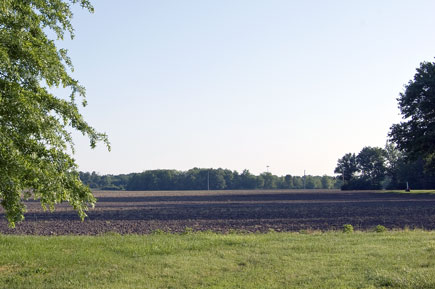
Deck’s Prairie Illinois farm view from South end in 2007.
My solo baseball practice was one half mile North West.
Photo by Rodger.
There was a somewhat strange game of baseball that I often played by myself at my grandparent’s farm. I practiced batting balls by tossing them up in the air and then hitting them on a field that had been plowed. The plowed field prevented the ball from rolling after it hit the ground. At age 8 or 9 I could not hit the ball much farther than 120 feet. The procedure was to hit 2 or 3 baseballs then walk to where they had landed and then hit them back in the other direction.
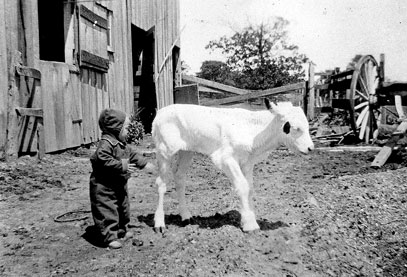
Barn at original Deck’s Prairie house 1950. The oak
forest and Silver Creek are 200 yards west in background.
Photo edit by Rodger 2007.
The topography of my grandparents farm, that I visited on weekends, for 8 years from 1947 to 1954, provided many varied playgrounds. The location was called Deck’s Prairie, near Highland, Illinois, but the farm was on the edge of a hardwood forest that had been partially cleared and was intersected by a creek, patches of trees, and gullies created by water erosion.
My cousin and I called an area that was heavily eroded into a series of gullies the piggybacks. The piggybacks were a network of connected dirt ridges ranging from 4 or 5 feet up to 15 feet in height. My cousin and I traversed them like a maze, after we learned the paths and connections. We sometimes climbed them and then walked the top of the ridge. My memories include the stress of climbing these ridges on a 100 degree summer day. It was a natural playground on a perfect scale for an 8 year old.
Epilogue and perspective: 50s children’s playgrounds
The dominance of imaginary and home made toys are a significant feature of the 50s generation. Reading vs. watching television is another significant difference for this generation. These differences and the impact on intellect and character have been extensively studied. Electronic media have great benefits but the downside is mostly ignored and not well understood. Some recent studies have concluded that language abilities are less well developed in children who consume large quantities of electronic media.
The internet generation of parents has developed personal strategies based on their view of the benefits or evils. Some allow unlimited access and others severely restrict and do not have a TV. Science Fiction novels of the 40s and 50s frequently portrayed a foreshadowing theme related to the prevalent education techniques and media. The education methodologies during that era were constraining intellectual development and programming children to think in narrow patterns. The result, according to this theme, was a population that would be capable of following recipes but incapable of creative or original thought. A liberal arts curriculum including Humanities, Social Science, and Arts was also part of the educational philosophy of that era. As a product of this education system and a participant in the high tech industry since 1966 I don’t believe that the worst fears were realized.