A child’s neighborhood is their first worldview. The short walk to the limited business district, town theater, playgrounds and schools defined the universe of 1950s neighborhood memories. Memories, relationships, identity, and a sense of security, evolve from neighborhood dynamics. A unique combination of sensual experiences, the layout of neighborhood destinations, and the location of extended family imprint 50s neighborhood memories.
A child’s 50s neighborhood memories are unique
A child’s 50s neighborhood memories reflect cultural and physical ambience that only someone who had lived there would recognize. Great River cityscapes, and small town social networks enhance the feeling that this place is a forever home. The sense of home does not involve, class, wealth, or status. Home is an inherent familiarity and comfort with recognizable features that a child resident could easily understand and a stranger from another town would never comprehend.
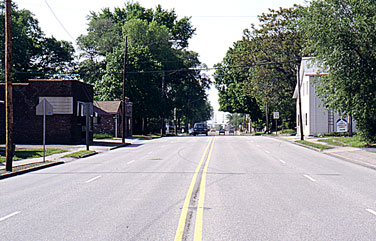
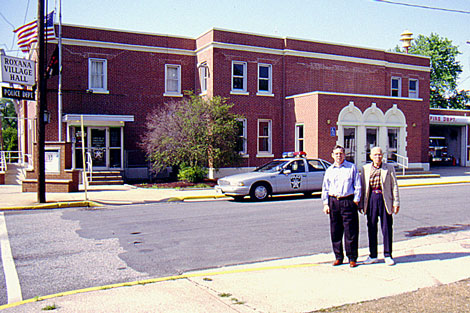
Roxana main street view 1998
The sensual experience from the sound of small airplanes, at the nearby Bethalto, Illinois airport, the odor of burning leaves, and the whine of the oil refinery steam turbines morphed a unique matrix of sensations. The combination identified the neighborhood. 50s neighborhood memories of Roxana Illinois will always be related to the sounds. Some sounds were audible 7 days per week 24 hours per day. There was never a minute of the 12 years I lived there that I did not hear the steam turbines in the Shell Oil Co refinery 1 block from my house. However, the sound was not bothersome. It was part of the environment, like a wind that you could barely hear. 10 years after I moved away from Roxana, when I lived near the Los Angeles Airport, the distant whine of jet engine turbines reminded me of the Roxana neighborhood.
Neighborhood destinations framed and connected memories

A short walk to Groceries and news
photo by rodger 1998
The layout of neighborhood destinations took shape on three blocks of Central Ave. The grocery store, barber shop, drug store, cafe, and post office were a short walk. Automobile traffic was rare. Shopping by walking created a social network on main street. As a result, local news was transmitted during the course of daily commerce.
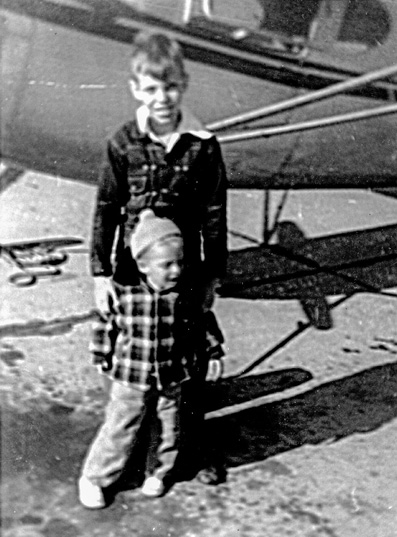
Sunday afternoon plane rides were a frequent family routine
photo edit by rodger
After my father completed his pilot’s license in 1947, I became tuned to the sound of small planes. My father flew over the Mississippi River and nearby agricultural areas on most Sunday afternoons in the summer. There was no commercial air traffic. The small airport at Bethalto, Illinois, about 5 miles distant would have a few flights per day. From 1967 to 1973 I lived near the Van Nuys and Inglewood California airports. From 1974 to present I have lived near the Long Beach and Los Alamitos, California airports. There is a lot of small plane traffic at those airports and the sounds remind me of 50s neighborhood memories.
Connections to neighboring cities expanded my universe
I was born at Alton Memorial Hospital 7 miles from where my parents were living in Roxana. The hospital is on a bluff overlooking the Mississippi River. The confluence of the Missouri and Mississippi rivers is a few miles south of Alton. The confluence of the Illinois and Mississippi rivers was a few miles north. My house in Roxana was about 1 mile from the Mississippi River.
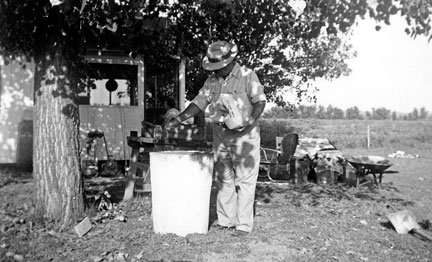
Illinois River fishing cabin 1949
Tiny town cityscapes mingled with great rivers were an important feature of my neighborhood. The trip to church on Sunday was along the bluff overlooking the Mississippi. Trips to shop at Sears in Alton, Illinois were on the River Road. The Grand Theater where I saw my first stereo sound Cinerama wide screen movie was in Alton. My uncle’s fishing cabin where I caught my first Bluegill was on the Illinois River. I learned to ride a bicycle at age 6 at Lincoln Douglas Park located on the river in Alton. In my neighborhood there was always a river in sight or just over the horizon. The gymnasium at the Community Building was often set up with target rings of various sizes and distances for fly casting practice.
Social networks and events created 50s neighborhood memories
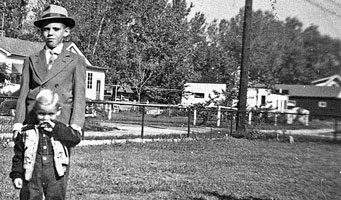
3rd street front yard commercial buildings center right
There was a large vacant lot just to the west of my house and in between my house and Central Avenue. The Community Center was on Central Avenue. Community events took place on the vacant lot. The space was about the size of 3 residential lots, 15 thousand square feet. However, it was large enough for a small carnival with a Ferris Wheel, hot dogs, and various games such as ring toss. A yearly event that everyone called the Fish Fry was held on the empty lot.
One of the attractions of the Carnival was the food. Hot dogs and cotton candy, a favorite menu for children, were plentiful and cheap. One of my 5th grade classmates ate 9 hot dogs during one of the carnivals and achieved instant fame as the hot dog queen.
Geography influenced leisure time and 50s neighborhood memories
Roxana was a few miles from the confluence of the Missouri, Mississippi, and Illinois Rivers. It seemed that everyone I knew was a fisherman. Fish was a routine menu item for many families. A large percentage of the 2000 residents participated in community events like the Fish Fry.
Community Center 50s favorite hangout basketball skills trampoline acrobatics and books
photo by rodger 1998
It seemed to me that the annual fish fry was attended by at least 50% of the population. It seemed like a large crowd to a child but was probably not more than a few hundred people. I don’t know who organized the fish fry. I remember the fish fry and the day after the fish fry. Usually there were some lapses in coordination for making change at the table where the food purchases were totaled up and paid for. On at least one occasion the whole change table turned over and spilled all of the change in the grass. This resulted in several children spending a couple of days crawling through the grass picking up pennies, nickels, etc. In those days a penny would buy small pieces of candy and 2 cents would buy one half of a Popsicle.
The Village of Roxana felt more like a neighborhood
The Shell Oil Co refinery was constructed, on property that would later become Roxana, Illinois, in 1918 before housing or a city were contemplated. The distance, from the Standard Oil Co refinery to the west, constructed in 1907, was about 200 feet from what would become Central Avenue. The distance to the Shell Oil Co refinery to the east of Central Ave was about 200 feet. Central Avenue divided the town in half between the refineries. If you stood at the Eastern edge next to the Shell refinery and threw a baseball west down 3rd street it would roll all the way to the Standard Oil refinery on the Western edge of town.
Third street, which bordered the south edge of what you might describe as downtown, was only 2 blocks long. The development that began in 1922, when the town was incorporated, was sporadic, intermittent, and disorganized. City offices, schools, and parks were none-existent for the first residents and then evolved slowly during the next two decades. Downtown is a short walk of 2 blocks. The northern border with the town of Wood River was 5 blocks.
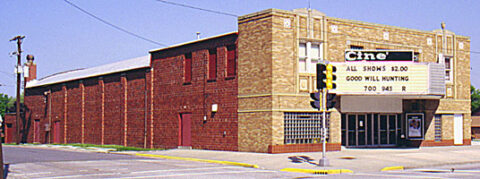
Roxana Illinois movie theater frames 50s childhood
fantasies and friendships in the 40s and 50s
Photo by Rodger 1998
A movie theater and high school were completed in 1940 to compliment basic city services. Third street bordered the south edge of what you might describe as downtown, which was only 3 blocks long. Construction of housing and city infrastructure had been completed by the time of my earliest memories in 1947. The business district had evolved to its final form of 7 small buildings scattered along 3 blocks of main street. The town population had stabilized at 2000. The serene pace of commerce and social interaction were established and ongoing.
Baseball geography promotes 50s neighborhood memories
50s children had developed a baseball focus by age 9 when they became eligible for Little League baseball. The definition of geography was the locations of space for baseball. Children played baseball, or often softball in small spaces, everywhere there was enough space. Children’s games did not require much space. Our front yard in Roxana was only about 60 feet long but it worked for baseball until I was about 8. After that we played catch in the front yard but no more batting or fielding balls.
Edison school grounds contained several places to play softball, at or adjacent to Edison School: the school was grade 1 through 4 so not a lot of space was needed for 9-year-old softball. I don’t remember playing baseball in this space. There was space on the East and West sides of the school with the West having a slightly larger space and a diamond with bases marked out. There were two baseball diamonds with backstop cages on the north side of the school. Informal games of workup, catch or a scaled down field in one of the small spaces for teams, seemed to materialize at any of these places. Within 3 blocks there were 7 areas large enough for elementary school age kids to play. Open space is a necessary element for a child’s habitat.
Small town extended families create emotional superglue

My mother’s childhood home with her sister and brother in law photo by rodger 1998
Aunt Myrtles fried chicken and creamed peas was my favorite meal. The best fried chicken served by an adoring aunt was a short walk down the street. Her recipe for cream peas was my favorite vegetable. The hospitality in the 1940s was simple, homemade and personal. The frequent family gatherings were for work and local sports related news and playing cards. There were no other children at these gatherings except my brother who was 6 years younger. This segment of family history was before Tv. The only entertainment for me was dominoes or blocks. Frequent interactions with cousins and other extended family who lived in Roxana added emotional dimensions to the neighborhood.
Human interactions in the context of the unique features of a neighborhood define a small town home. The master planned cities that became common in the 1970s and 1980s, Irvine California and other cities in Orange County California are good examples, designed the function, ambience, and recreation before construction on the first house started. The beautifully landscaped parks, manmade lakes, flower gardens, and nearby shopping malls all enhance family life. I don’t know if any of the children who grew up in Irvine experienced the kind of emotional superglue created by the hot dog queen or crawling through the grass to find change spilled during the Fish Fry. Did the urban planners who designed the highly functional and efficient Irvine, California villages consider the shape of childhood memories?
50s neighborhood memories extended to grandmothers house
The Hundred Acre Wood of the Winnie-the-Pooh stories is in actuality five hundred acres in Ashdown Forest in East Sussex, England near A. A. Milne’s country home at Cotchford Farm. He imagined his characters as he walked this forest on his daily childhood routines. The hundred-acre forest that I explored, as soon as I was able to venture out on my own at age 6 or 7, was on the edge of Deck’s Prairie near the town of Highland, Illinois. Michael Deck, a Revolutionary War veteran, led a wagon train from Virginia to settle there in 1828. My great grandfather built a log house and started a dairy farm there in 1885.
Silver Creek bordered the eastern edge of the farm for about 1 mile and ran through approximately 100 acres of the forest. The forest decreased the area of the farm for crops and created a perfect playground for an 8-year-old child. Although the creek was narrow and shallow, not more than 6 or 7 feet deep for most of its length, my great grandfather fished there on Sunday afternoons. The abundant grape vines wrapping the trunks and branches invoked visions of my favorite action hero, Tarzan, swinging through the jungle on vines. Swinging across the creek, from one high bank 15 feet above the creek to the other side, would have been challenging for an advanced gymnast. I had sense enough to avoid the attempt. My personal 100-acre wood is part of the emotional superglue that connects memories of my Illinois home.
50s childhood memories backstory and perspective
The words highlighted in blue are links to the backstory for the events and locations that I have described in this post. Please follow the links for the events leading up to the 50s childhood memories.
I wonder if the writer has a photo of Burbank School which was on the corner of Thomas and Central in Wood River, not far from the Roxana Theater. My husband attended school there in 1952-53. I have acquired a couple photos of the school, but they are not as we remembered it. One is the original, and the other has a covered walkway added. My husband graduated from Roxana High School in 1960. I grew up in East Alton-Wood River, and am familiar with Roxana. My husband and I lived on Central Ave from 1999-2007, and drove by/walked by the old school many times but never thought about taking a photo of it.
I was glad to see this wonderful story on the internet.
Hilda: thanks for the blog comment: I don’t have a picture of the school, there are pictures of main street, my house on 3rd street, the theater, and the High School in blog posts, I appreciate your and others reactions to the blog. My goal is to preserve and communicate the 50s small town culture. If you know of anyone who is reading the blog to ask them to leave comments. My family were dairy farmers there from the early 1800s. My father was transferred to Washington State in 1955 so I started a different life but Roxana and the dairy farm will always be home.
Rodger Immer – I am on Facebook you are welcome to send me a friend reqeuest