I frequently walked a field road on the northern border of a Southern Illinois farm. Various common hardwood trees created a dense canopy of fall season colors. Strange weather patterns caused an early fall season biological phenomenon.
We called the east end crossing of Silver Creek the ford. The creek was very shallow there and ran across solid ground. Before tractors, horses and wagons crossed the creek there. I walked across the creek and barely got my shoes wet. 80 years of use eroded the road several feet below the level of the fields on either side. Hardwood trees on the edge of the field canopied the road.
The field road connected a paved road, Prairie Rd, to the north end of the fields where crops were grown and to Silver Creek. Other crossroads, some well-known and some obscure were a short walk or a short drive by car. Michael Deck, one of George Washington’s bodyguards, came from Virginia in 1828 by wagon train to farm on the prairie. The William and Clark camp and Mark Twain’s trips as riverboat captain are 20 miles west on the Mississippi River. The sense of this place has many dimensions.
Strange days
The fall season weather, a few miles northeast of St Louis across the Mississippi river, causes strange days of early frosts and summer like temperatures. Winters are normally mild. However, the first frost can occur in early October. I have vivid memories of fall season walks down this road. An early frost started the fall season colors 1953. The temperature increased to 95 a few days later. Fallen leaves of Oak, Maple, Cherry, and other common Illinois hardwood trees layered the road. The remaining leaves in the canopy obscured the fields and created a tunnel view. Sunlight, tinted yellow, gold, red, and orange, filtered through the branches overhead. The warm fall breeze rustled the fallen leaves as they crunched under foot. The sights and sounds of the field road saturated the senses.
Awesome beauty
Fall season colors transformed the field road into a place of awesome beauty. I cannot travel to this location to revisit the field road experience. The construction of Interstate Highway 70 in 1967 buried this section of the farm under concrete. I have very vivid memories of my fall season walks down this road and lament that I will never see it again.
There is an Illinois Visitor Center East of Saint Louis on Interstate 70 a few miles West of Highland, Illinois. The building is on the South side of the highway. The GPS coordinates of the Visitor Center are N 38° 47.288 W 089° 41.329. The distance from the Visitor Center to the location of the original log house built in 1885 is a few yards. The back door opens to the playground behind the Visitor Center. The playground is located where the backyard of the house was located. The field road was about 100 yards north of these coordinates. The family took few pictures during this time and none in color. The image link here is from the Saint Louis area and is representative of the fall season colors.
Nostalgia to cry for
I usually walked this road alone. My brother was 6 years younger and did not come with me on these treks. My aunt and uncle were sometimes playmates or more accurately a baby sitter since they were much older. They did not walk with me. Generations of my family used the field road but they did not experience it the way I did. This field road was my personal space and could not have the same meaning to anyone else. It was more than a sense of place, it was my sense of place. The location near a pond, that was behind a barn, next to a creek, on the edge of an oak forest defined a unique place. A child travelling an ancient trade route with a caravan in the 13th or 14th century experienced a similar feeling for a familiar place they had travelled to several times.
Memory archives of an adult trek to beauty
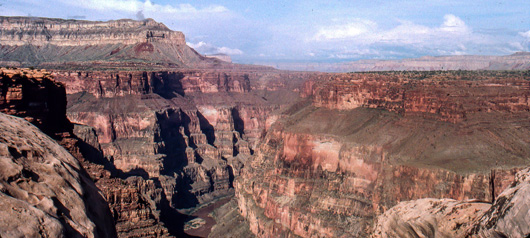
Toroweap overlook north rim of the Grand Canyon strange days of dramatic storms and a majestic river
The field road is gone. My search for beauty and solitude became a life style. My wife’s Park Ranger profession reinforced my motivation for treks to beauty. I camped with my son at a location named Toroweap Overlook on the North Rim of the Grand Canyon in 1992. This destination is not an easy to reach. The route choices are either from St George Utah. via 85 miles of dirt road over an 8000 foot mountain pass or from Fredonia, Arizona via 65 miles of dirt road.
Toroweap Overlook is in Bureau of Land Management and is usually deserted except for cows. The camp ground, at the time of my visit, had a Ranger Station to manage the site. This is one of the few places where you can look down to the Colorado River from the Rim. It is an Oh My God view. Toroweap Overlook has been there for thousands of years and likely thousands more, but the field road is gone.
Tom Sawyer saw scenes like this
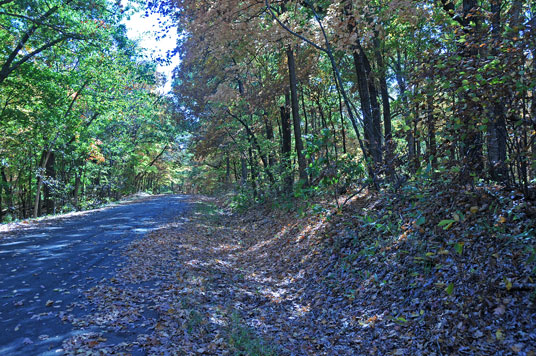
Mississippi River road fall colors near Hannibal Missouri 2011.
A view likely seen by Mark Twain in the 1840s.
Photo by Rodger.
I have read Mark Twain. I don’t recollect any description of fall season colors for Tom Sawyer. Mark Twain saw fall colors, like those in this picture, on the roads and trails near Hannibal, Missouri in the 1840s. I shot the image above in October 2011 on the river road a few miles south of Hannibal. The location is approximately 100 miles north of the field road I walked in 1953. The river road is a reasonable facsimile of my experience. The river road is paved and much wider than the field road. Mark Twain received his riverboat captains license in 1859. He travelled down the Mississippi within a few miles of the location for the field road. His view of fall colors in the 1850s would have been very similar to mine in the 1950s.
Mark Twain’s perspective, as expressed by Tom Sawyer, was not an adult view of roads as a transportation system. The links to caves and other boyhood hang outs were much more important than the commercial use. The field road, from my perspective, was just as a path to the creek and forest. The fall season colors created a unique and special never to be forgotten place. The nostalgia is to cry for.