Elementary school reading textbooks in the 1950s were titled Streets and Roads. Stories in the books were about a family and their neighborhood. Children named Dick and Jane were the main characters. The children’s story was about places and connections by way of streets and roads.
Streets and Roads in the neighborhood define a child’s universe
Dick and Jane’s hometown for the story is not specifically identified. Roxana, Illinois is the location for this story. Events are as of 1947 to 1955. After several years of ad hoc development in the area, that began in 1908, the Village of Roxana was incorporated in 1921. The population was 2000 in 1947. Adjacent towns of Wood River and Alton were also small towns, with population less than 10,000. Roxana is about 2 miles from the Mississippi River and about 20 miles from Saint Louis, Missouri.
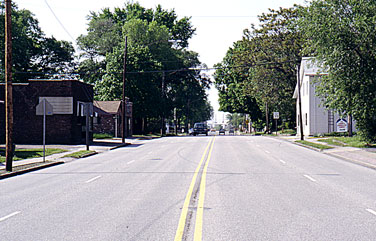
Main street Roxana, Illinois 1998. A sparse
shopping district for out daily commerce.
Photo by Rodger 1998.
The street map of Roxana shows a town that was only 2 blocks wide from 8th street to 1st street. City offices, the theater, shopping, and schools were all within a 2 block radius. As a result, the small scale created a neighborhood atmosphere. We shopped, went to the movies, and attended school events on foot. We created a social network of personal links with frequent face to face contacts. There were no strangers. Everybody new your name.
Well trodden paths connect children’s habitats
We made frequent trips for household activities to many locations. Because the short distances did not warrant it, we did not make trips in a car. My mother never learned to drive and during that time we did not always own a car so the logistics suited our situation.
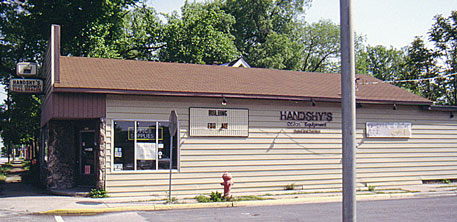
Roxana Illinois grocery store 1998. A 1940s business
has adapted to the new retail world.
Photo by Rodger 1998.
We purchased groceries at a store one block north on Central Ave. Because we did not have much storage space for perishable items, trips for groceries were more than once per week. The dry goods store across the street from the grocery store stocked sewing and household items. We got haircuts and picked up mail at the barber shop and post office one block farther north. Drugs and medical supplies were on the west side of Central Ave in the same block as the grocery store. The drug store stocked ice cream and popsicles. I bought one half of a popsicle for 2 pennies. My mother paid utility bills at the city offices across the street from my house on 3rd street.
Sounds along the streets and roads
Landmarks, buildings, sounds, and other sensations define the feeling of home. Because we lived about 3 miles from the small airport at Bethalto, Illinois for 8 years, one of the sensations of home for me is the drone of small planes. Sounds of small planes became part of my life at age 4. After my dad completed his commercial pilot’s license in 1947, I flew in small planes with him. Due to the proximity of the Shell Oil refinery in Roxana, less than half a mile from my house on 3rd street, I could hear steam turbines. They sounded very much like the jet engine turbines that I would hear 2 decades later in California while living in Inglewood.
Commercial air traffic at Long Beach Airport was audible from my residence in North Long Beach, California where I had moved in 1966. My apartment in Van Nuys, California was near the local airport. In Inglewood I could hear the sounds from the flight path and the engines of the planes taxiing on the runway at Los Angeles International airport. From my house in Orange County, California the frequent drone of small plane traffic at Long Beach Airport brings back memories of life in Roxana.
My aunts and cousins lived down the street
The streets and roads map of my neighborhood included my relative’s family residences. My mother’s family had moved to Roxana from Higbee, Missouri in the 20s. My father’s family had lived in that area of Illinois since the early 1800s. They moved back to Illinois in 1937 after living in Colorado and Missouri.
The geography of my relative’s residences defined links in my neighborhood. Some of my aunts, uncles, and cousins lived one half mile away. We were only 20 miles from many more. This phenomenon resulted from large families. My father had 4 siblings and my mother had 8. The small area of towns contributed to the neighborhood effect. I could walk to my aunt’s house in Wood River in about 15 minutes. Family farm heritage strengthened the neighborhood links. Everyone on a family farm works together every day and how well you work together determines whether you eat or go hungry.
Family gatherings occurred at least once per week, usually more often. The routine visits were: church on Sunday, lunch after church on Sunday, dinner and pinochle during the week, desert and pinochle during the week, news for union and labor issues, news for local sports, and plans for fishing trips. Television ownership was not common in Roxana until 1952. TV was not part of the extended family routine.
Streets and roads around the corner
After age 7 I rode my bicycle or walked to locations that were a few blocks or up to a mile from my house on 3rd street. Locations around the corner included: the grocery store, the Roxana movie theater, aunt Myrtle’s house, the baseball field, the Community Building, the Wood River swimming pool, the movie theater in Wood River, the Elementary School I attended, the High School where I attended games and played basketball, and my cousin Tyke’s house.
We occasionally ate at a local restaurant, we called the Sweet Shop, one block North on Central Ave. The sweet shop, a hang out for elementary and high school children, also had a soda fountain and a candy section. 9th street was the way to aunt Myrtle’s house. Ferguson Ave. was the way to church then on from Whitelaw to the Wood River Pool. Memories and emotions for these streets and roads were imprinted by frequent trips by foot and bicycle. I made 20 trips or more each year to these locations from 1950 to 1954. Trips to the Wood River pool were 3 or 4 days per week during the summer.
In 1954 we moved 2 miles to a new house in a developing suburb named Rosewood Heights. The move expanded my neighborhood. I often walked to the old neighborhood locations.
The center of my streets and roads universe
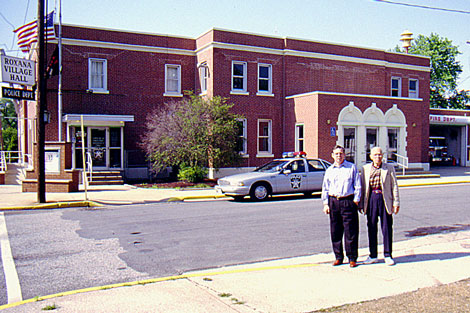
Roxana Illinois Community services building 1998. Completed in 1938 it had a basketball court Library and city offices.
Photo by Rodger 1998.
The community center in Roxana, built in 1938, was called, strangely enough, the Community Building. This building, about 100 feet from our house on the other side of Central Avenue, housed city offices and recreational facilities. Community meant everything that anyone or any club in the community could do indoors.
The Community Building facilities provided: preschool during the day, casting practice for members of the fishing club, basketball for the Shell Oil Co employee leagues, costume balls for children at Halloween, a stage with curtains and lights for theater presentations, weight training equipment, a library, a trampoline and more. Before I was old enough to play basketball I used the building as a playhouse. Kitchen facilities and hallways, adjacent to the gym, served as various make believe domains. I used porches and steps on the outside of the building for climbing and jumping to simulate action hero moves. When I visited in 1996 the city offices were still housed there.
Reading habits at age 8
My reading at the library, a frequent destination, was connected to my Comic Book reading habit. Hard cover collections of stories about Batman and Superman were much longer with more detailed story lines. World War II battles were covered extensively on early TV and the movies in the late 40s and early 50s. I read and reread all of the books in the library on WWII fighter aircraft. The specifications for performance and weapons were memorized. Post WWII movies, the surge in interest in aviation after the war, and my father’s stories about the planes that he had observed in the Pacific war operations fueled my interest in airplanes.
Empty spaces on the streets and roads
A child’s web of life must include playgrounds. There were vacant lots on Central Ave in the downtown area and on many other streets. The Roxana downtown area never developed beyond the businesses that were established in the 30s and 40s. After WWII the development for both housing and businesses was in the suburbs. Roxana always looked kind of incomplete because of this sudden ad hoc then arrested development. The vacant lots were destinations for a variety of childhood games. There were two within a block of my house that we frequently used for baseball. Large lots were not needed for 8 year old baseball. Kite flying was a frequent activity. Some lots had fruit trees or small gardens. The vacant lots were part of my childhood web of life.
Basketball locations on the streets and roads
Basketball was the sport with the most fans in small towns 40s and 50s America. Attendance at High School games often filled the seating capacity at the gym. There were about 2000 seats. The population of the town was 2000. Basketball is the subject of other posts on this blog.
The last 2 years before we left Roxana we had a well developed procedure for doing the gym rat thing on Sunday afternoon. The terminology gym rat refers to little animals, meaning children, that were always in the gym. They may have gotten in through a windo9w that was not closed and were very difficult to get rid of. One of the members of our church, Vince, was a janitor at the High School. He unlocked the gym at the high school for us after church. There were usually just a half dozen or so people from church. We played some small team games and practiced dribbling and shooting baskets. Sometimes there were only 3 or 4 people at the Sunday sessions. We each had our own court to practice on.
Basketball memories revisited
On one of my business trips in 1995, I stopped by Highland, Illinois to visit my aunt. Since the gym at Roxana was nearby, I watched a high school girl’s basketball practice for a few minutes. Because I often played there for practice and Junior High School games, there were intense feelings of being at home. I had not been in that gym for 40 years.
There were locations, other than the High School, where I frequently played basketball. The Community Building had a gym, which was always open on Saturday mornings. Edison School for Junior High practices were held at the Edison Elementary Scho0ol. I played on the out door courts at the High School and on courts in the vacant lots.