A child’s universe is down the highway on Illinois Route 143
Illinois Route 143 connects towns down the highway from Alton, Illinois on the Mississippi River to Highland, Illinois. The State of Illinois applied the Route 143 designation to former Route 127A at Highland, Illinois in 1937 and extended it west to Alton by 1964. Route 143 follows the river on the Illinois side for a few miles, and is designated as part of the Great River Road, then turns Southeast and East to Highland, Illinois.
The link above shows a current view of the towns, country roads, and intersections that marked the destinations and signposts of my childhood.
Roxana, Illinois is about the same population in 2019 as the 1950s when I lived there. Alton, Illinois, where we shopped, has grown. Marine, Illinois, where my ancestors lived in the early 1800s, has not changed. Route 143 is 50 miles long. The location of this highway on the Mississippi River and rural Illinois roads and highways bonds the culture and shapes the routines of small town life.
Family life ebbs and flows down the highway
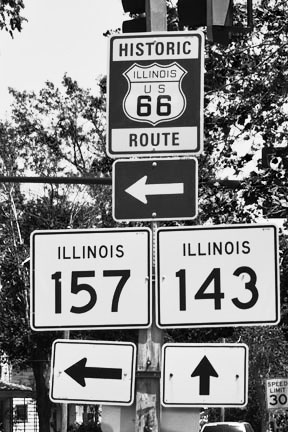
Edwardsville Illinois intersection is the way to
grandmother’s. Weekly trips bind family life.
Photo by Rodger 2007
My family life ebbed and flowed on Illinois Route 143. I travelled this road North 7 miles from Roxana, Illinois to Alton, Illinois for shopping and movie theaters. We travelled East to the family farm near Highland and my Uncle Fred’s house in the city of Highland. The trip to Highland is about 25 miles and travels through small agricultural towns like Edwardsville and Marine. Part of the route through Edwardsville was Route 66. These trips and the destinations defined the crossroads of my childhood.
This route, including all the twists and turns through the fields of corn and wheat and the intersections that connected small towns in the area, created a deeply imprinted memory. A church in Edwardsville, built in 1867, is still there. The train station in Edwardsville, where my father returned from WWII, is gone. The most frequent destination was grandmother’s house, near Highland. These routines created a feels like home experience. They were an extension of my childhood habitat. The unique feeling of comfort and anticipation of the destinations were my personal sense of place.
We traveled this road an average of once per week from 1947 until we left Illinois in 1955 when I was 12. The towns and farms have not changed much. Although I moved to a different state decades ago, this highway still feels like home. One of the themes in child psychology is that children love routine. This routine created a feeling of comfort and peace that is still very strong. The phrase sense of place, used in cultural and environmental interpretation, applies. Highway 143 feels like home to me. Sometimes I imagine that I could walk blindfolded from the intersection of 9th Street and Route 143 in Roxana to Highland 25 miles away.
When I was young I dreamed of highways
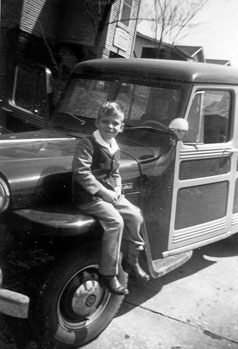
Willys Jeep first car 1948. Transport
to church and grandmother’s house.
Photo edit by Rodger 2007.
I dreamed of locations on Illinois Route 143. Roxana did not have stores with appliances and household items. We shopped for shoes, clothing, and other household items at the Sears store in Alton. We also shopped at a five and ten cent store. I travelled to Alton by bus with my mother for shopping trips. The Roxana theater played classic and second run films. Theaters in Alton played films that had just been released. I saw my first Cinerama movie, The Robe, and heard my first stereo sound track at the Grand Theater in 1953. I went to church in Alton until I was 8 when the church moved to Wood River.
The Cosmetology school that my mother attended, dance studio where my brother took lessons, and Lincoln Douglas Square where I learned to ride a bicycle at age 6 were on Route 143. Alton is a split level town. The commercial district is at the same level as the Mississippi River. The residential section is on the bluffs about 200 feet above. We went to the hilly section for sledding when there was snow. I was born at Alton Memorial Hospital.
The Illinois River is in a child’s habitat
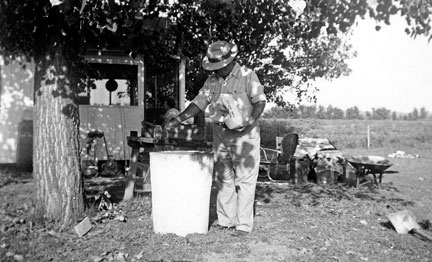
Uncle Louis cleaning fish at Illinois River cabin near Hardin 1949.
Substitute father during WWII, best friend, and dedicated fisherman.
Photo edit by Rodger 2007.
The highway became the Great River Road where Route 143 ended, North of Alton. My uncle’s fishing cabin on the Illinois River was 35 miles farther North at Hardin. The cabin was a home away from home. We had family reunions there and my uncle took me fishing there during WWII when my father was in the South Pacific. The Illinois River not only absorbed my childhood senses it expanded my awareness of the world of biology. Willow trees at the waters edge were larger than I had seen anywhere else and the branches expanded out into the river and touched the water. The reflection created an image much larger than the tree itself.
The Illinois River is habitat for an insect called a Mayfly. The web page has more information about this insect. Eggs hatch at the river bottom to become aquatic nymphs then molt with wings to become flying insects. The last stage, consists of another molt to larger wings. The last state and mating, takes place in days or sometimes minutes. Billions of the insect from one hatch and can form clouds as large as a rainstorm. The hatch that I saw on the Illinois River, in the afternoon sun with reflections of the insects and Willow trees on the water, is the most spectacular scene I have witnessed. I saw this at age 4. I have been to 65 National Parks.
Down the highway to grandmother’s house
Many destinations on the Eastern end of Illinois Route 143 defined focal points of my childhood life. The 25 mile Sunday afternoon trips to grandmothers led to a montage of playgrounds and childhood habitats. When my mother was ill I stayed at grandmothers house. We visited my grandmother on most week ends and sometimes during the week. We made ad hoc trips to grandmothers during the week for my father to visit his parents and brothers and sisters.
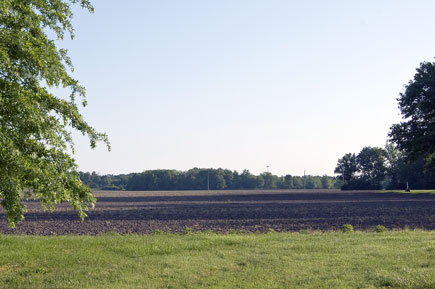
Immer family farm on the East side of Prairie Rd my 50s childhood playground
My explorations of my grandparent’s 270 acre farm discovered many varieties of playgrounds. I found a field road through the edge of a forest, a creek, a pond, a hayloft, a hardwood forest, target practice with my rifle, long walks through the fields with the dog, and solo baseball practices. We often stopped at a drugstore in Edwardsville, on the way, to get ammunition for my day’s target practice. We purchased a box of 22 caliber short rifle bullets for about 80 cents. I started carrying a rifle on my walks at the farm at age 8, which was not unusual for a farm family in the 50s. During warm summer evenings, we drove to grandmother’s for informal ice cream socials after little league baseball games. We always made the ice cream from a family recipe, it was not purchased.
Down the highway and across the river
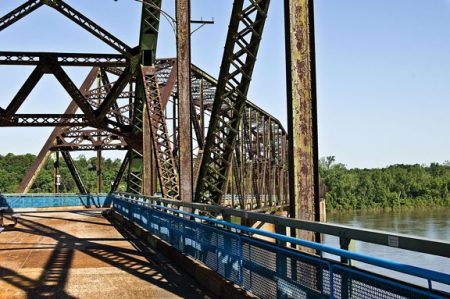
Route 66 from Illinois to Missouri after closing in 1966
family trips to Saint Louis Zoo in the 50s
Photo by Rodger 2007
We usually crossed the Chain of Rocks Bridge over the Mississippi River to get to Saint Louis, Missouri. This bridge was the route for Route 66 to cross the river. We used Route 66 for travel to Saint Louis for the Forest Park Zoo and Cardinals baseball games. These trips, of about 25 miles, were only for family entertainment. We never shopped at retail stores.
The Chain of Rocks Bridge opened in 1935, as part of the nation crossing Route 66 highway project, and closed in 1966. After closing it was converted to a State Park. The state maintains foot and bicycle traffic for the one mile crossing, providing a lot of beautiful views of the river and St Louis. My walk through the park across the river in 2007 was intensely nostalgic. Chain of Rocks bridge is both a signpost and link to many childhood memories.
The bridge is very narrow by modern highway standards and had a 45 degree bend in the middle to accommodate the geology of the river. Bridge design followed outcroppings of rock in the river instead of drilling down to bedrock. Traffic slowed to a maximum of 45 mph at the bend in the middle of the river.
Childhood attractions in the 50s
The Saint Louis Zoo at forest Park was a primary attraction for my family. Anticipation of these trips, which occurred almost every year, were at the same level as family trips to Disneyland for later generations. The Zoo was rated one of the best in the world in the 1940s and 50s. The animal acts that I saw at the Saint Louis Zoo were similar those performed in the travelling circuses like the Ringling Brothers. There were lion and tiger acts, chimpanzee acts, elephant acts, and others. The reptile building was the most interesting to me. Alligators swan in the moat in the middle of a very large atrium. The anacondas impressed me more than anything else.
My family went to Forest Park and the Zoo for a farewell family reunion when my father was transferred to Washington State in 1955. My uncles, aunts and cousins from the Immer part of the family participated in that reunion. Family baseball games, the picnic, the animal acts, and the leisurely walks through the park defined a fitting end for that stage of our life. A new job and a new life waited for my father and our family in Washington State. I was eleven years old. I did not fully comprehend the depth of the old life I was leaving behind or the changes coming in the next few days.
More childhood attractions across the river
My father planned a trip to the circus at the Kiel Auditorium in Saint Louis when I was 5. He got the date for the circus wrong. An ice hockey game was scheduled for that day. My memories of the ice hockey game are vague. We did not follow Ice Hockey and did not know much about the sport.
My father rescheduled the circus trip. I do not remember the circus acts. I remember the display of animals tethered or in cages in the large hallway that provided access to the auditorium. We fed peanuts to an elephant that was tethered in the hallway. Physical contact with animals characterized the culture of the time. The parade of animals and performers entering the auditorium created a lasting impression. A stunt showing many clowns getting out of a tiny car amazed me. The vision of the crowd of clowns dwarfing the car lasted for many years. I would still like to know how they did that trick.
A clown walking on very high stilts captured my attention. My dad made some stilts for me that were not nearly as high, probably not more than one foot in height. The bottom of the stilt was just a 2X2 board so it was quite tricky to walk on them and required a lot of balance and coordination. I don’t remember any other stilts in the neighborhood so it was not a common toy.
Baseball heroes are down the highway
My father, grandfather, and uncles were all baseball fanatics. During the summer there was almost always a game of catch on Sunday afternoons at the farm. My uncle Robbie was the pitcher and my dad and Uncle Fred were the catchers. The game of catch was often played while listening to a Cardinal game broadcast. The radio was placed in an open window adjacent to the game of catch. I sometimes listened to the broadcast and watched the game of catch. The family were all Cardinals fans and usually knew the current big league standings on a daily basis.
The family did not have season tickets and did not attend major league baseball games often. During the late 40s and early 50s the St Louis Cardinals were still playing at a ball park in St Louis called Sportsman’s Park. The facility was known by that name before Anheuser-Bush was involved with the team. This stadium was very small by today’s standards, about 30,000 capacity. It was built in 1908 on the site where previous baseball stadiums had been since 1866.
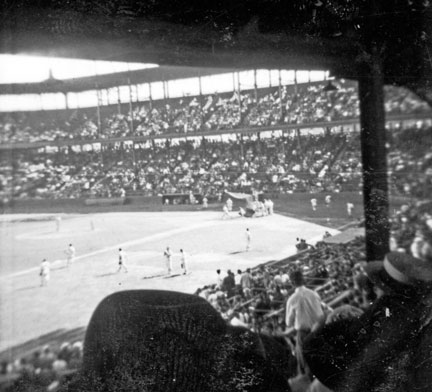
Immer family baseball fanatics at Saint Louis
Cardinals Sportsman’s Park
photographer unknown 1940s
The first time I attended a game I was 5 or 6 and very impressed by the physical structure. The building was huge compared to any other building I had seen. There was no huge parking lot or parking structure in those days. Most of the people who came to the game walked or rode public transportation. I can remember the names of many of the players that I saw. Before baseball players won free agency rights decades later, they played for the same team their whole career.
Family generations down the highway
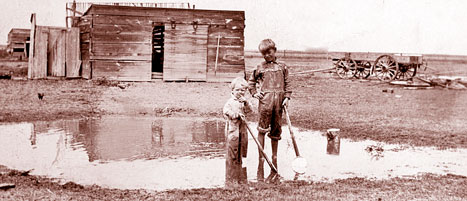
Children make a playground out of a mud puddle after an Eastern Colorado
storm in 1925. An 1885 Illinois farmer’s son has moved to Colorado.
Photo edit by Rodger 2007.
Julia Kelley, my great grandmother, relocated her family, including children from 3 marriages, from Hartville, Missouri to the Eastern Colorado plains in 1914. Her second husband had purchased land to begin farming. The strength of this family endured the depression and dustbowl. Children and grandchildren served in WWI and WWII. Her children’s successful farms grew to 6000 acres.
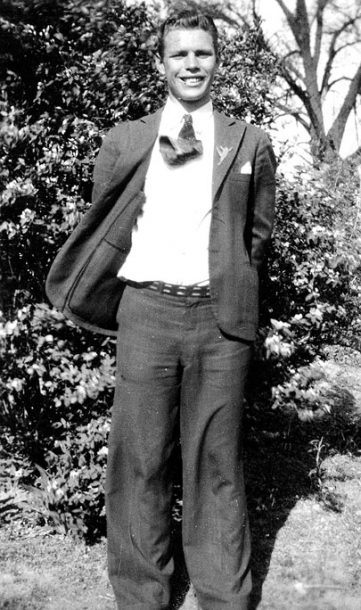
Best generation high school graduate and loving grandson
Photo edit by Rodger
Her grandson, Clifford Immer, developed a deep appreciation for the character of this matriarch. After his parents had moved to Independence, Missouri and he graduated from High School, he travelled across the county to visit his grandmother. He used freight hopping, jumping onto a moving freight train, as his method of transportation. Follow the link for more information on the history of freight train hopping. The economy and the transportation system dictated this method of travel. Freight hopping began after the Civil War and was used extensively by middle and lower class travelers during the early 20th century. The highway system was incomplete and car ownership uncommon.
Freight train hopping was routine and dangerous
Freight hoppers did not have any public information for schedules or routes. They learned from other hoppers or observation of the traffic. The route, where the train switched tracks to go in another direction, and where it stopped for water, were necessary information to navigate to the desired destination. The trip would likely take longer than 24 hours if the destination was several hundred miles. A knapsack with a sandwich and a piece of fruit provided one meal if you were well prepared.
When my father got to the train stop at Eads, Colorado he had a 17 mile walk for the last part of the trip to her farm on the prairie. The walk would be hazardous during the winter. Frost bite and scar tissue on nose, ear, or fingertips was a common feature of plains residents. Freight train hopping was dangerous. Everyone knew the risks and accepted them. Fatalities occurred every day. They were not newsworthy.