My agricultural roots childhood memories began in 1943 when I was born during WW II. I lived on the family farm while my father was deployed as a Sea Bee in the South Pacific war. The Immer family put down agricultural roots in Madison County Illinois in the early 19th century. My grandmother Cuma Sibcy Immer who had married my grandfather in 1917, experienced her agricultural roots childhood memories in the Missouri Ozarks near Branson, Missouri. Her 19th century small town culture was illuminated by a 1907 novel, Shepherd of the Hills, that was the first American Novel to sell more than 1 million copies and became required reading for Missouri High Schools. This location attracted Laura Ingalls Wilder to move there in 1894.
By the third generation in the early 20th century, some of my great grandfather’s children had moved to other states for farming and other occupations. My grandfather, Fred Immer, had moved to Colorado and then Missouri. When my great grandfather died in 1935 the farm was inherited by his daughter Ida. The dairy farm had been idle for 2 years when Ida agreed for her brother to move his family back to Illinois to resume farm operations. My father, who had moved with the family back to Illinois, accepted a job at Shell Oil Company in nearby Roxana, Illinois at age 23 in 1940. The country was still in the depression, so it was a great opportunity. From my earliest childhood memories at age 4 until I moved from Illinois to Washington state in 1955 my visits to the dairy farm on a prairie bordered by a hardwood forest illuminated my agricultural roots childhood memories.
1885 dairy farm agricultural roots childhood memories
The Eastern edge of Deck’s Prairie, in Madison County, Illinois, was not well suited to a dairy farm. The dairy farm was located about 2 miles from the small town of Highland, Illinois. The size of the farm, purchased by my great grandfather, was 270 acres. Half of that acreage, occupied by hardwood forest and erosion from water runoff, could not be planted. The topography and layout of the dairy farm provided a perfect domain for a child to explore.
The crops fed the horses that planted the fields and the cows that produced the milk. The family sold the crops not consumed by the animals for additional income. My great grandfather cleared part of the hardwood forest to create more land for cultivation. His first language was German. His English translation for the work to remove the stumps of trees he had cut down was, “making out” stumps. He did this work in the rain. Horses hitched to the tree stump pulled it out of the rain softened ground. The “grip”, was his description for the flu like symptoms of sore muscles and fatigue the day after.
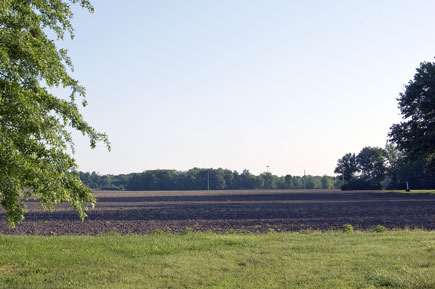
Deck’s Prairie Illinois farm view from South end in 2007.
My solo baseball practice was one half mile North West.
Photo by Rodger.
Silver Creek bordered the Eastern side of the farm for about 1 mile. Prairie Road bordered the other side. Hardwood forest, totaling about 50 acres, remained along Silver Creek and small patches on the South and North ends of the dairy farm. The fall colors, solitude of the canopied creek, and surprise encounters with quail, squirrels, and rabbits defined the sense of place and the nostalgia to cry for. Fireworks for 2 weeks in July, listening to baseball games on the radio in the window, practicing baseball on the adjacent field, shooting arrows, and exploring the forest and creek on the field road defined and expanded my childhood universe. The hay loft in the barn doubled as a play area for me when the weather was too cold to be outside. The loft and the barn served as alternate childhood recreation and leisure locations during the winter. They were slightly warmer and the barn offered a make-believe domain of mountains and tunnels constructed from the hay bales.
A revolutionary war veteran settles on Illinois prairie 1828
Deck’s Prairie is approximately 10 miles north of St Louis, Missouri and 20 miles East of the Mississippi River in Illinois. This area was a crossroads for Native American and European culture for more than 1000 years. The Indian village of Cahokia had a population greater than London in 1100 A.D. The confluence of the Mississippi, Missouri, and Illinois Rivers is 30 miles Southwest. The Lewis and Clark camp for the expedition was a few miles from here. The French explorers Marquette and Lafayette came up the Mississippi to this location in 1673.
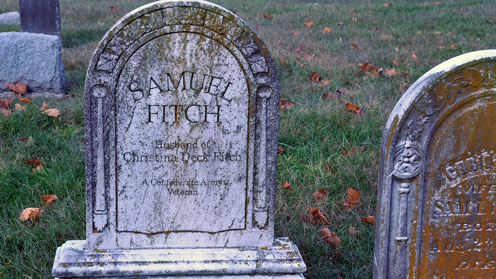
Grave site for husband to Christina Deck Fitch, Michael Deck’s
daughter. Cemetery on Illinois HWY 143 west of Highland.
Photo by Rodger 2011.
George Rodgers Clark, William Clark’s brother, and Michael Deck, one of George Washington’s bodyguard’s, scouted Kaskaskia in Southern Illinois for British Activity during the Revolutionary War. Michael Deck liked the area near the current city of Highland, Illinois. The grave site is for Michael Deck’s grandson who served in the Civil War. Settlers from Virginia, Kentucky, Switzerland, and Germany put down agricultural roots in this part of Illinois. Their descendants experienced 50s childhood memories during the era of radio, movies, television, and baseball.
50 years later, in 1828, he led a wagon train with friends and relatives to Illinois to settle. The area is very fertile prairie and has had crop yields among the highest in the US. Michael Decks family and friends began planting agricultural roots childhood memories 10 years after Illinois became a state in 1818. Before the first census in 1820 this location was designated as the Silver Creek area. His homecoming to this area signified an American history connection. He had camped a few miles from there with George Rodgers Clark in 1778, near the Lewis and Clark camp site in 1804. The Kentucky frontier residents had already started moving west to Illinois. My great-great grandfather Oswald Kile was born in this area one year earlier in 1827.
There are no signs to identify Deck’s prairie except for the Prairie Rd sign on Illinois HWY 143. A plaque on the South edge of the cemetery, donated by Michael Deck, provides a brief history. The are no other signs The cemetery is on the north side of HWY 143 between the cities of Highland and Marine. As of my last visit in 2011, the State of Illinois Visitor Center on the North end of Deck’s Prairie did not have any information on the area history.
Rural survival skills agricultural roots childhood memories
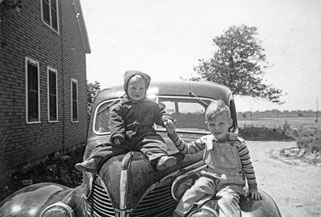
North side of original house in 1950. The log
walls have been covered in siding.
Photo edit by Rodger 2007.
My great grandfather built the original log house in 1885. He created a home on empty prairie using his construction skills and hand tools. He prepared for moving in by: finishing lumber from harvested trees, digging the well, building the house, and planting an orchard and a garden. This work, if done on schedule, will get your family in out of the cold with something to eat for dinner.
The outside was finished in composition siding and there was a shake roof on the second story when I first saw it. The first story was about 800 square feet with two small bedrooms, a kitchen, and a living room. The second story was a one room loft with access by a stairway in one of the bedrooms. The loft was the bedroom for the boys in the family. When I visited on the week ends I slept in the loft. The loft doubled as a play area for me when the weather was too cold to be outside. The temperature was a few degrees higher than the outside temperature. When my grandfather and his family moved from Independence, Missouri back to the farm in 1937 they lived in this house.
Lunch at grandmother’s house on Sunday was an endearing family custom, the weekly family gatherings reinforced and enhanced multigenerational relationships. The routine, which continued for 8 years, added a dimension to the sense of place and was an essential ingredient of 50s childhood memories.
Country school agricultural roots childhood memories

Deck’s Prairie residents walked to school in rain, snow,
or ice storms. School buses were in the distant future.
Photo by Rodger 2007.
A system of roads and a school district served the residents of Deck’s Prairie, about 16 square miles, in 1885. The one room country school provided education for the small number of families and had approximately 15 students for grades 1 through 8. My grandfather and aunts and uncles attended this school from the 1890s to the 1940s. The local historical society maintains the school as a museum. With generations of classmates, the school taught grades 1 through 8 and an optional grade 9 and 10, the composition of the class often included brothers and sisters. The neighborhood routine, covering several square miles included walking to school in rain, sleet, snow and 100-degree heat on dusty dirt roads
Economics and technology influences agriculture
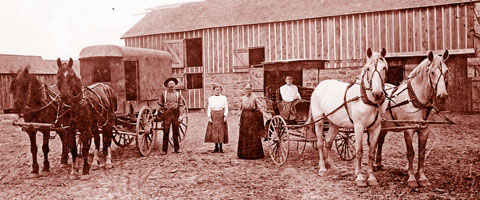
Decks Prairie Illinois dairy farmer 1915. Success means two buggies.
One for work and one for going to town.
Phot0 edit by Rodger 2008.
The growing economy and successful farming enabled the construction of a new house on the other end of the dairy farm in 1900. My great aunt Ida, born in 1895, is about 20 years old in the picture. I do not have any pictures of the original house and am not sure that any were taken. The second house was much larger, about 2000 square feet. A bedroom, kitchen, and living room were on the first floor and 3 bedrooms on the second floor. A cellar under the house and a smoke house in the back yard enabled on site storage and preparation of food. The house was set back from Prairie Rd about 150 feet. A barn built for horses was behind the house within a few yards of the hardwood forest that had not been cleared.
The barn at the second house used for horses was smaller. The construction of the second barn involved a unique feature. The floor for the hay loft on the second story was made of Cherry. There were Cherry trees in the forest and the wood is very dense and strong so it was good material for construction. Cherry is currently used for very expensive furniture and would never be used for constructing a barn or house. The barn was about 35 feet by 25 feet so the Cherry wood in that building would have filled several houses with furniture. The present value of that wood is staggering. The flooring was taken out and sold sometime after the farm became inactive.
Agricultural roots American history connections
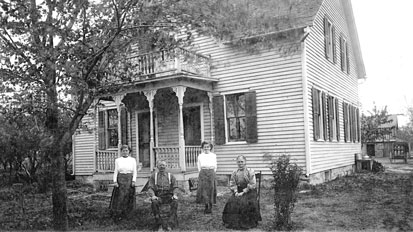
Deck’s Prairie 2nd house Fred Immer family 1915.
Photo edit by Rodger 2012.
My great aunt Ida lived on Deck’s Prairie from 1895 until she died in 1979. She stayed on the dairy farm to take care of my great grandmother Annie when she became ill. My great grandfather died in 1935 and Annie died in 1948. This period of history encompasses changes in culture and technology that are subject matter for several college history classes. A vastly oversimplified list might include: electricity, air travel, 2 world wars, the Indian Wars, atomic energy, and electronic media. There are 19th century settlers with descendants living in the area . The history of Deck’s Prairie is another project.
Rural life agricultural roots shape childhood memories and adult identity
My childhood orientation to the structure and organization of the rural work life, the comfort and expectation of the daily and seasonal cycles, and the importance of the solitude and constant immersion in the natural world that I grew to expect and treasure, created an emotional matrix that endures through my adult life. My adult understanding of relationships, family, and friendships has always reflected the interaction with my aunts, uncles, cousins and grandparents at the dairy farm.
The dairy farm was on a prairie; however, it was bordered on 3 sides by a very diverse hardwood forest and on the east side by Silver Creek. The ambience of sounds from the creek, the rustle of leaves with fall colors, and the small but dynamic habitats of life in the pond that always sparked my interests for any fish or insects that I had not seen on my previous visit, defined a unique and private sense of place. The dramatic difference between the feeling of being alone with nature in the forest or at the creek from the living room at the farmhouse with the adult activities and interaction with adult personalities, seeded my adult lifelong interest in biology and geology.